Mommy! Daddy! Stop Fighting!


The NFL:  hypocritical, anti-poker and awesome.


How could my two favorite things have so much in common yet be locked in mortal political combat? 

That’s the question I asked when I discovered the following tale of gambling melodrama on my honeymoon.  You’ll have to forgive me if I get some minor facts wrong.  This is not a blog about politics and I sure as hell am not doing any major research on this stuff.  But the gist of the story is this:

The Unlawful Internet Gambling Enforcement Act (UIGEA) was passed awhile back.  While the poker players of the world stood idly by (the Poker Players’ Alliance was only created in the aftermath of bill’s passage), other groups did plenty of lobbying with the friendly Congressmen from the Christian Right who were responsible for the UIGEA.  One of these groups was the National Football League, who paid a guy named William Wichterman, a former employee of Rep. Bill Frist, the douchebag who first conceived of the UIGEA, over $200,000 to spearhead their lobbying effort.

Wichterman evidently did a good job, because the law that was passed defines gambling on sports as a prohibited activity but expressly exempts fantasy football (along with state lotteries, trading stocks, horse racing and some other stuff) from the reach of the UIGEA.  The NFL’s dual goal of protecting the sanctity of its game from the evil influences of gambling and preserving the rights (and associated income) of millions of dudes like me who play fantasy football was accomplished.

I’m not going to bother discussing the hilarity of the lottery and horse racing exemptions and will focus for now on how big a fucking joke the fantasy football exemption is. 

First of all, fantasy football is gambling.  It is a game of skill–and that is the exact grounds under which Wichterman advanced the cause for the carve-out it received–but as sure as Brett Favre crams his old white ass into tight pants every Sunday, fantasy football is gambling.  Groups of guys all over the United States pool their money, pick their players, then watch their players compete against the other guys’ players, and in the end someone wins the money.  You’re betting on players.  It’s gambling.  But it’s a form of gambling that has become exponentially more popular in the internet age and has somehow never become too socially stigmatized, unless you count calling those who participate nerds.  Either way, it is a huge revenue source for the NFL and Mr. Wichterman accomplished his goal of keeping it easy to play.

Second, the fact that the NFL draws a sharp distinction between the supposedly insidious “regular” football gambling and friendly ol’ fantasy football (and successfully lobbied Congress to enact legislation containing that same distinction) is unadulterated bullshit.  While I understand that blowing your life’s savings on the Bears/Vikings game in Week 4 is a lot easier to accomplish than losing your entire net worth in a fantasy football league, both forms of gambling are in fact games of skill.  And if you don’t believe me on that you’ll just have to trust me. 

Also, while fantasy football is a major revenue source, the amount of NFL interest generated by fantasy football is a drop in the proverbial bucket compared to what the mere availability of sides and totals on every game accomplishes.  The NFL’s product is perfect for gambling, the numbers are printed in every newspaper in America, it’s legal in Nevada, and hundreds of radio and TV pundits openly discuss these numbers on a daily basis.  Everyone, including the NFL, knows that “regular” gambling is a very big part of what makes football America’s game.  Gambling on football is as old as the game itself, for god’s sake.  It’s still more convenient for the NFL to continue with its “sanctity of the game” charade since they know full-well that the demand for action on its product is strong and inflexible, no matter what they say.  It’s better for the NFL to continue with its near-monopoly on sports gambling (look at the numbers sometime, only the NCAA tourney comes close).  So the NFL threw a bunch of money around and the UIGEA, tacked onto the back of an anti-terrorism bill, became reality.  Like I said earlier, the cardplayers of America were asleep at the switch:  the word “poker” never appears anywhere in the legislation and as such is treated the same as the lethal blight of football gambling.

Fast forward a few months:

The UIGEA reads like it was drafted by a drunk nimrod and it didn’t take people long to discover this.  The UIGEA requires America’s banking institutions to police themselves by coming up with regulations designed to restrict the flow of money to and from offshore gambling entities.  “Easier said than done” is an understatement with regard to accomplishing that, so the banks basically shrugged off this new responsibility and chose to do nothing at all.

In Congressional discussions (what are Congressional discussions called–“sessions” or something?), several groups stepped forward to pronounce the UIGEA and its proposed regulations a big pile of steaming shit.  The most vociferous objections came not from sportsbooks, poker sites, degenerate gamblers or libertarians, but from from our country’s banks, who unanimously stated that the regulations would be expensive, wasteful and impossible to enforce.  Then a long period of time passed by in which nothing happened.

Then came November 10th, 2008, one week after Obama’s election (and two days after my wedding).  On that date, William Wichterman–now no longer as an emissary of the NFL but gainfully employed by the Bush Administration as a “Deputy Director of Public Liaison” (whatever that is)–was up to his old tricks again.  Um, it’s been awhile since I took that ethics class, but this sounds a little bit conflict of interest-ish to me.  The UIGEA, supposedly at the behest of Wichterman, suddenly became a major priority and the UIGEA regulations became the subject of what is known in political circles as a “midnight drop.”   This apparently is what they call it when an outgoing administration pushes through a pet project or two before exiting the premises.  And so on November 10th, the Treasury Department finalized the regulations.  It remains to be seen what the Obama administration (or for that matter, the banks) will do with them, but they’re on the books for now.

The point of this blog entry isn’t to rehash my slanted version of the history of the UIGEA but rather to highlight the NFL’s role therein and to point out what unlikely enemies poker and the NFL are.  Poker and football provide America with two of its greatest pastimes and I with two of my great loves.  Not coincidentally, poker and the NFL provide us with two of our country’s most common forms of gambling.  Yet while poker must fight for legitimacy (particularly online), the NFL is so powerful that it has been able to influence lawmakers and keep its gambling-infested world in perfect order.

So, to Mr. Roger Goodell and the other bigshots at the NFL I have this to say: 

Dear Sirs,

I love your product and would be lost without it. 

But kindly eat me.

DZ
Catching Up, Part II: I Got Married.

Once the afterglow of our engagement faded, Janeen and I faced the task of putting together our wedding weekend.  Like any sensible man, I dealt myself out of most of the planning, leaving the big decisions in the capable hands of my fiancee and her mother.  As they began their work, the picture that slowly emerged was of an upscale November affair in a fancy Chicago hotel.  Fine by me. 

Although I was thrilled to let Janeen and her mom do most of the planning, I did want to somehow put a personal stamp on the weekend (without any cheeseball poker references).  I’ve been to enough weddings to know that the guests are there at least partially because they’re expected to be there.  At best, they attend because they are somewhat obliged to “share in your happiness.”  At worst, being at the wedding is a outright drag.  So when I learned that I’d be asking my friends and family to travel a long way and spend a lot of money, I resolved to make my wedding fun, specifically for my friends.  Your great aunt is probably going to have a nice time at your wedding regardless of what the party’s like, but the people you hang out with on a weekend-to-weekend basis are going to be a bit more discerning.  Notwithstanding the limitations any wedding planner faces, I wanted a party that they’d enjoy.

Everyone has a different idea of what is fun, and frankly I wasn’t about to speculate on or really accomodate anyone else’s concept.  I’m lucky to have a big network of close friends who are familiar with and share in my version of big city fun:  late nights at bars, concerts and clubs, with music always playing a central role.  And the kind of music that moves me is the kind of music you can lose yourself in; preferably something funky, raw and improvised.  Something a wedding band is incapable of producing.  While a band that makes you say “Oh, ‘Living on a Prayer!!’ I LOVE this song!” has some merit, my version of a good band makes you say “Jesus, these guys are killing it!” instead.  So with Janeen’s blessing, I decided to ask my favorite band to play my wedding.

I discovered Milo Z in 1995 or 1996 when I went to see the Meters at Tramps.  Per usual, the Meters tore the place up, but it was the opening act that really blew me away.  They did funk music the right way, with a big sound driven by tight horn arrangements.  During the solos, the bandleader had a James Brown-esque control of the rhythm section, instructing them how many times to play their vamps (“two times!”).  Their songs were funny in the same way old school hip hop was funny:  songs about sex, songs with dirty nursery rhymes, plays on words, crowd participation with the vocals.  It all amounted to a convenient excuse to bounce to the bass and let the horn riffs fill your earholes.  I was smitten.  I became a Milo Z devotee, attending countless shows around the city for many years and introducing the band to everyone I knew, including Janeen.  If you hung out with me sometime between 1996 and 2003, chances are you and I caught a Milo Z show together.  And most everyone agreed with me:  it was a guaranteed good time; Milo Z brings it.  My friend Steve does Milo Z some justice in this entry on his blog, check it out.

In early 2008 Tramps was long gone (replaced by a dance club that I often frequented–that club is also now closed), but Milo Z was still working the NYC circuit.  I contacted the band’s manager and ever-so-slickly dropped the names of many discarded songs and ex-band members to prove that I was a legit old school fanboy.  She must have been suitably impressed, because after she conferred with Milo, we struck a deal.  She said they didn’t normally play weddings, but would make an exception for me.  Milo Z at my wedding.  Sweeet!

Unfortunately, my first ever concert booking set off a chain reaction of events and expenses for which I was woefully unprepared.  I had booked a New York band to play a Chicago wedding.  The band needed to be flown out to Chicago, needed transportation in Chicago, needed hotel rooms in Chicago, needed instruments and sound equipment in Chicago and needed a sound guy in Chicago.  All these issues were my responsibility and many turned out to be way more difficult than anticipated.  I also had to account for Milo Z’s shortcomings as a wedding band:  namely, I had to find a long recording of a Jewish Hora, recordings of songs for the traditional dances Janeen would have with her father and I with my mother and grandmother, and Janeen and I had to personally program the music that would be played at the ceremony, as there is no harp player in Milo Z’s crew.  It was a ton of work.  Overnight, I had gone from your basic groom-to-be to a club promoter.  So much for my detached indifference with respect to the wedding planning. 

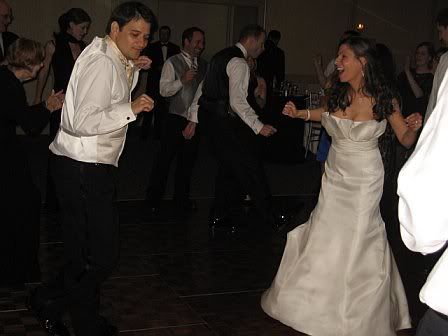
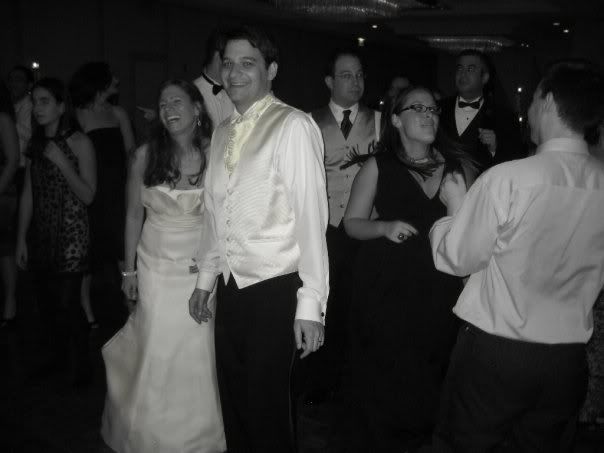
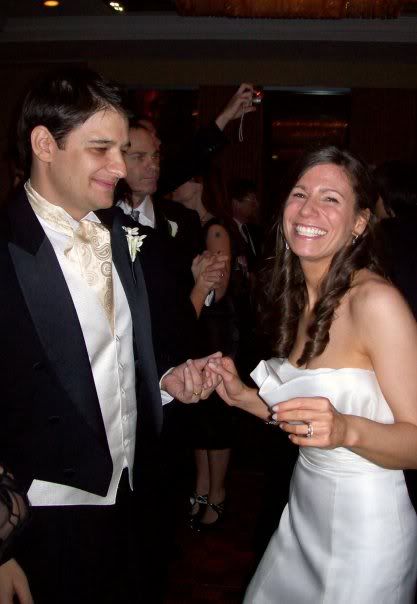
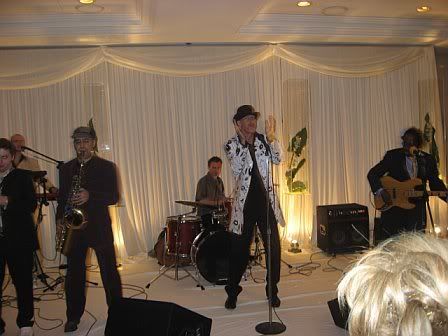
Milo Z’s gig at my wedding was a closely guarded secret.  I wanted to surprise my friends, many of whom were at the introductory show at Tramps and many shows thereafter, and would surely appreciate the surprise guests.  In the end, although some of the older guests might have preferred a band that played “Unchained Melody,” I’m happy to say that Milo Z was a huge hit, although the surprise was ruined for many when the band was spotted at the hotel’s front desk.  The band was kind enough to learn and play “Sunny” (originally Bobby Hebb, but oft-covered), which they played for our first dance.  From that point forward it was a typical Milo Z show, and they even played 20 minutes of overtime when we didn’t want to leave the dancefloor.  By the end of the night, I had achieved exactly what I wanted:  my new bride and I dancing with our friends to that real live funky getdown on the getdown.


Milo doin’ werrrk.


White man’s overbite + happy bride

The entire wedding weekend was a success, I think.  All the planning done by Janeen and her mother was evident:  during the whirlwind of activity, I was still able to appreciate how good everything (including Janeen!) looked, how tasty the food was and how happy our guests were.  Everyone thinks their own wedding was the bees knees, so take that commentary with a grain of salt.  Only the guests are really qualified to rate the party, so you’ll have to talk to someone who was there. 

I do know this:  Janeen and I are blessed to have so many people in our lives that love us and support us.  That statement is eye roll-worthy boilerplate post-wedding blabbering, but I have special reason to believe that it’s the truth.  During our wedding weekend there were a number of speeches given on our behalf.  It was quite a speechy wedding–in fact, Milo Z’s second set was delayed because all of the speeches ran long.  But the speeches were neither boring nor repetitive.  Some of the speakers were invited, some were not.  Each person had something different to convey, and each speech came from a different angle:  some took a comedic or sarcastic approach and some were tender and heartfelt.  Some were throughly planned, and one person even employed visual aids.  Others were completely improvised on the spot.  The sentiment was nevertheless the same throughout, and it was obvious that each speaker held Janeen and I in high esteem.  I remain touched and grateful after listening to them and I’m likely to remember each of them forever.

And now here are some more pics.  I’ve lifted these from other people’s facebook accounts, so thanks guys.

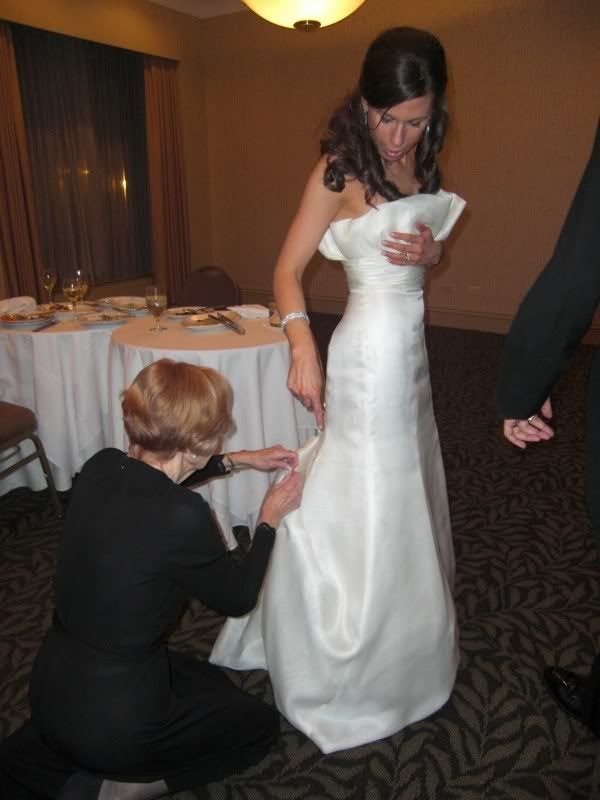
bustle dat ‘ish, mom.


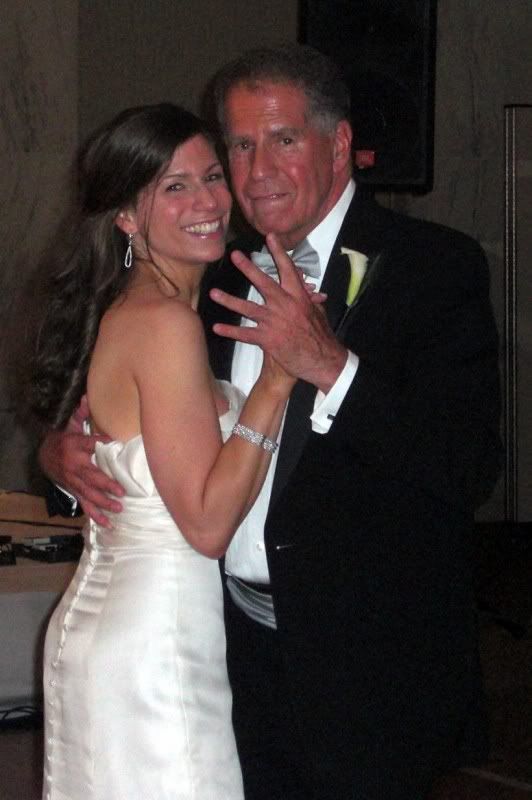
Janeen & her dad. 


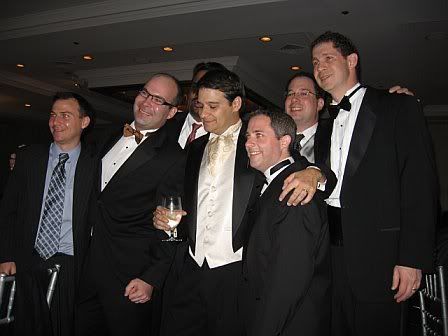
I have a lot of good, old friends.


yayyyy


yayyyyy again

Catching Up, Part I: NYT Rejects.

Janeen and I are back in Brooklyn, home from our honeymoon.  All tolled, between our wedding and South American adventure, we were away from home for about three weeks–a long time for us.  My devoted readership undoubtedly wants to find out what we were up to!

Alas, I have no desire to write about the whole thing right now.  But as a special favor, I am going to try and create a piecemeal recap by doing entries every couple of days.  Being that this is supposedly a poker blog, I will start with something tangentially related to my career.

It wasn’t long after our engagement in February that I was made aware of one of Janeen’s lifelong dreams:  to appear in the New York Times’ Sunday wedding announcements section.  Until February, I had lived out my sad little life blissfully unaware that this all-important section of the Sunday Times existed.  As a matter of fact, the allure of the Sunday New York Times has always escaped me.  Back in my single days (when I prowled the internet for my prey, a diversion that eventually led me to Janeen), I poked fun at how many J-Date profiles included a reference to “cuddling in bed, reading the Sunday Times on an autumn morning” in their “perfect relationship” essays.  As it turns out (at least, or so I’ve heard), much of the civilized world really does read the Sunday Times in bed–an activity that ranks just above Chinese water torture on my personal list of preferred leisure activities.  To the average educated Joe, fifteen hours of pro football is somehow less interesting than the Sunday Times.  Who knew?

As the months passed and our wedding approached, I dutifully took a look at the Times’ wedding announcements section to see what all the fuss was about.  Based on strength of Janeen’s desire for our names to end up in there, I had presumed that Times-worthy weddings would be some seriously high-falutin’ shit, but they’re not.  It says “Weddings/Celebrations” and then there’s about thirty or forty entries, some of which get extensive writeups and some of which don’t.  I found a smattering of the semi-famous and extremely accomplished–like bigwigs in the publishing and advertising worlds–but mostly I saw your basic white-collar schlubs marrying other white-collar schlubs:  lawyer marries teacher, advertising VP marries hedge fund guy, chemist marries doctor, etc.  Sometimes there were little unexciting blurbs attached.  “Michael and Sarah met at an accounting conference in Phoenix Arizona, where they made a happy discovery:  they lived on the same block on the Upper West Side of Manhattan.”   Didn’t seem like such a big deal to me.

Wrong!  Janeen was quick to correct me:  it’s quite hard to make it into to the Times, very few couples’ applications are accepted, and it would be the greatest thing ever if we made it.  Okay!  My beloved fiancee was really gung-ho about this so I was totally on board.  I imagined Janeen and I forty years from now, opening a dusty scrapbook and showing our grown children the moldy, yellowed Times clipping, with Janeen chirping pridefully about what an honor it was.  I resolved to help any way I could in our effort to become sort of famous by appearing in the Times.

When our wedding was only two months away, Janeen did her homework on how to prepare an application for inclusion in the Times’ wedding announcements.  It wasn’t much:  some biographical info and a close-up picture (“make sure your eyes are aligned horizontally”).  I did my part, describing myself as a “former attorney, now accomplished poker pro,” and Janeen sent it off. 

Then came an exciting development!  It turned out that Janeen’s brother and sister-in-law both knew people at the Times.  One of them was tight with the wedding announcement writers.  Someone took a look at our application and emailed some good news to Janeen:  that “it shouldn’t be a problem.”  We were a shoo-in.  This made Janeen very happy, and I was happy that Janeen was happy.  On November 9th, 2008, all those couples who really do read the New York Times in bed could have this wondrous exchange:

“Hey honey, look at this.”

“Yes dear?”

“Look, a poker player married a legal recruiter.  They’re from Brooklyn, but the wedding is in Chicago.  She has curly hair.”

“Wow.”

But trouble lied ahead.  As our wedding day approached, there was no word from the Times.  Janeen began to sense there was a problem.  On the Tuesday before our blessed day–deadline day for submission and approval–Janeen had her brother poke around for some info.  Then the crushing blow was delivered:  The Times considers poker a sport, and it only accepts the wedding announcement applications of “highly ranked” professional athletes.  Since I was not “highly ranked,” we were denied inclusion.  The writer explained that this was the decision of the editor and that there wasn’t anything that could be done unless I could somehow prove my worthiness of inclusion based on the standard of being “highly ranked.” 

As you might imagine, this left me feeling really indignant, but I hurriedly collected links to everything on the internet evidencing my success in poker:  my Pokerpages profile, articles about my tournament wins, a list from 2006 showing that I finished in the top 50 in the world in tourneys with buyins under $1000, even discussions on this website about how much I’d accomplished.  It failed to impress.  A guy who grinds out a living at poker isn’t good enough for the Times, you’ve got to be Phil Ivey.  We were out.

Now I felt indignant, wounded and disappointed.  Disappointed not for me, but for Janeen.  Anyone who knows me knows how integral my pride is to my persona.  The entire process of switching careers was an arduous undertaking for me.  The absence of a safety net in my chosen profession is a constant challenge.  Summoning the courage to forfeit the comfort and economic stability of my old life in exchange for a much more uncertain existence ranked as greatest accomplishment of my life to that point.  Actually succeeding in my new venture made it even sweeter.  Now Janeen and I were being told that I wasn’t good enough; the things I’m proud of accomplishing in my life were completely lost on the Times.  The worst part was that we’d be assured of inclusion had I never bothered with the poker.  It hurt a bit.  Had I chosen the path with the safety net and continued with my old career, I’d have been rewarded with a little blurb in the Times; another attorney getting married, and my fiancee would be ecstatic.  Instead, even with our inside connection, we were out because some editor at the Times (that bastion of liberal enlightenment) felt that I was not qualified for his wedding section.  I guess he was convinced that I was just a random unemployed guy who likes poker. 

Memories of the worst beat of my poker life came home to roost, too.  I thought to myself that had any card other than a five fell on the river when I was heads up for that bracelet we’d have made it.  If “poker pro David Zeitlin” wasn’t good enough, “WSOP bracelet winner David Zeitlin” probably was.  I apologized to Janeen, who assured me that she didn’t want the Times if the Times didn’t want me.

Then there was a sudden unexpected glimmer of hope.  Janeen’s brother’s connection was obviously a good one.  The writer at the Times was really trying to come through for us despite her editor’s ruling.  On Tuesday at around 3:00 we received an email from her.  She was convinced that she could get us more than included in the section; she could get us top billing–the lead story couple with the long and glorious entry–if we could provide her with an angle:  a compelling story about my change of careers and how it affected our relationship, or a description of what a loving relationship with a poker player is like. 

“Maybe there had been a struggle between David and Janeen’s mother with respect to the poker?” she asked.  Um, no–there was never anything like that at all.  But I was willing to type up some bullshit for the cause.  “Oh, by the way,” said the writer, “the deadline is in a half hour.  See what you can email me.” 

Working furiously (literally and figuratively), I concocted a story about winning both Janeen and her mother’s heart and proving myself in the poker world.  Janeen’s brother chipped in with the true story about meeting me and conducting a quick cross-examination on me.  The emails arrived before the deadline, but our fate was sealed for good when the editor (allegedly) had to leave the building early that day.  Our last ditch effort was for naught.  Add “feeling jerked around” to indignant, wounded and disappointed.

The writer apologized to us for not being able to come through.  I apologized to Janeen for being the reason one of her dreams could not become reality.  She did a good job of convincing me that she wasn’t that upset over it, and we moved on, hoping that it wasn’t a bad omen for our wedding weekend.

Why let all that bullshit I typed up go to waste?  I now present to Janeen (and the rest of the world) our wedding announcement, which I will publish myself, right here.  The New York Times can eat a dick.

Janeen Berkowitz and David Zeitlin

In his career as a professional poker player, David Zeitlin routinely makes dangerous high stakes split-second calculations.  In her career as a legal recruiter, Janeen Berkowitz has a discerning eye when it comes to selecting candidates for positions at her prestigious law firm.  In a decision that wasn’t nearly so difficult for the two ex-lawyers, Janeen accepted David’s bid to marry her in February of this year. 

David’s unusual career was initially a hot topic.  “When I first met David, he was an attorney with unusual career aspirations.  He was appearing in court every day and playing high stakes poker in New York’s card clubs a few nights a week.  My friends and I initially referred to him as ‘Gambler McShady.’  The connotation wasn’t entirely positive,” explains Janeen.

“I told Janeen about the poker on our very first date,” says David.  “I’m not sure if she knew what to make of a successful Jewish ivy-educated lawyer who had his sights set on a career as a professional gambler.  I was making quite a bit of money on the side playing cards recreationally, and in January of 2006, after giving about three months notice at my job, I officially made the jump and joined the pro poker tournament circuit.  Within a few months I notched my first six-figure cash by winning a pretty big tournament, and I’ve never looked back.  I make a better living doing this than I ever did as a lawyer.  And needless to say, being your own boss and making your own hours is a very nice perk.”

“It didn’t take me long to realize that David was talented, driven, and quite serious about his new career,” says Janeen.  “He was a good lawyer, but he’s a great poker player.  He found his calling.”

“I travel with him whenever I can–It’s a lot like the golf or tennis tour, I’d imagine.  I’m his rooting section.  I know all his opponents’ wives and girlfriends, too.  If you had told me two years ago that I’d be part of a tight-knit community of poker players’ wives, I’d have said you were crazy. But I really enjoy it!  David’s a self-made man and I admire that.  I am so proud of his success as poker player.”

The couple were wed on November 8 at the Westin Michigan Avenue in Chicago.  They reside in Brooklyn and are both really cool.  Too cool for the New York Times.

Obama.

I loathe political discussions and completely avoid them.  Nothing ever gets accomplished with them.  But last night has moved me to make an exception and write a little something.

Maybe I’m getting old and sentimental.  Or maybe I’m just ferklempt over my wedding, which is this coming Saturday.  But last night made me proud.  Last night restored my faith in America, and I felt more American pride last night than I ever have before.  That’s no small statement from someone who lived in New York on Semtember 11th.

I’m proud to live in a country where the past eight years can be peacefully–but soundly and thorougly–rejected, like they were last night.

I’m proud to live in a country that at its core really is progressive.  I’m proud to live in a country that will put a black family in the White House based on merit.

I’m proud to have experienced a general election that caused spontaneous cheering out my window, with my neighbors hugging in the street.

I’m proud of our new president and excited to see what he can accomplish.

The McCain supporters I know all voted McCain for the same reason:  taxes.  They are all people who earn a lot of money and they can’t stand the thought of parting with some of it.  Nevermind that this election, at least to me, was about much more than finance.  Having had the experience of earning quite a bit of money in two different spheres, I have strong feelings on the issue of taxation. 

In my last blog entry I mentioned the sense of entitlement that young lawyers at my old firm had.  That same false sense of entitlement actually permeates much of America’s monied class.  I believe that the average American is honest and hard working.  I believe that Americans end up in their respective professions for a variety of reasons:  differences in opportunity, individual desires and aptitudes play a large role.  I believe there is dignity and value in all manner of work.  Having now worked in two very different occupations, and having a family tree with a background in numerous, wide-ranging professions, I can honestly say that I see ZERO correlation between salary earned and an individual’s value added to society.  If you don’t agree with that, then you might be offended by this, and you’ll probably call me a socialist:

If you make more than $250,00 a year, what makes you so goddamned special?  You’re smart enough and fortunate enough to have received a higher education, and you’ve parlayed that into a lot of money.  Good for you.  But I’ve lived amongst you, and you’re nothing special for having that money.  If your goal in life in just to accumulate money, you’re sad.  Become a doctor because you love medicine.  Become a lawyer because you enjoy thinking analytically.  Become an investment banker because you like doing whatever the hell investment bankers do.  Become CEO of your company because your out-of-control ego demands it.  But don’t exist only to make money, and for god’s sake, stop thinking you’ve accomplished so much because you’ve stashed all that cash.  Congrats on “making it,” buddy.  But really, who are you?  There’s nothing about you thats more worthy than a high school math teacher or an electrician or even your secretary.

I’m sorry, but I see nothing nothing unreasonable about asking you to give some of that money back.  I guess I’m a socialist. 

Thanks for reading my amateur political jibber-jabber.  And now Janeen and I are off to get married.  I know that many of the people who read this will be with us in Chicago.  We can’t wait to celebrate–both our new president and our incredible good fortune–with you!    🙂

The Return of Mo’ Sun.

A couple of days ago I played a poker tournament in Connecticut’s newest poker venue, the Mohegan Sun Casino.  “Newest” is actually a misnomer since Mohegan Sun is neither new to poker nor to me.  When I walked into Mo’ Sun’s still-familiar confines, a funny thing happened.  I felt some pangs of unexpected nostalgia. 

To enter the poker tournament, I needed a Mohegan player’s club card.  Mohegan Sun is now much larger than I remembered it, so it took me some time to locate the player’s club booth.  I eventually found it, and as the attendant handed me a shiny new card I asked him, out of curiosity:  “could you tell me the last time I gambled here?”  He poked around on his computer and had an answer for me within a few seconds.  He smiled wide and said “2003!  It’s been awhile, Mr. Zeitlin.  Welcome back.” 

Indeed.  Mohegan Sun is a relic from another time in my life. 

If, like me, you were fortunate enough to graduate from an Ivy League law school in 1998, you were in a good spot.  The economic climate was very different from the gloom of today’s financial marketplace.  In fact, I’d say the conditions were completely the opposite.  In 1998, if you could provide your prospective employer with proof of moderate scholastic competence at University of Pennsylvania Law School and accompany that with the slightest glimmer of ambition, you were rewarded with a six-figure job at a big law firm.  And that is exactly what I was given, along with all of my law school friends. 

One might think that handing over $100,000 to a 24-year old whose only significant accomplishment is completing law school would make that person humble and appreciative, but you’d be wrong.  In actuality (circa 1998 at least), the average first-year associate at a big NYC firm quickly cultivated a remarkable sense of entitlement, matched only by the bullishness of the prevailing legal job market.  Unbelievably, I received no fewer than three market-based pay raises in my first year out.  Each time, the sequence of events was the same:  One major firm would announce an increase in their pay scale.  Associates at my firm (and all the other big firms) began to openly salivate.  Some other firms would match the pay raise.  Associates at my firm (and at the remaining holdout firms) became incensed, bitching and moaning at every turn and in every forum open to them.  My firm eventually caved and gave us all a raise.  Rinse and repeat.  By the time my first year was drawing to a close I was making something like $125,000.  Pretty neat!

I spent my days doing what junior litigation associates do:  occasionally drafting legal memoranda and document indices, but mostly firing snarky emails and instant messages back and forth to my similarly situated friends, being sure to stay at my desk until at least 7:00 every night, whether I had work to do or not (you gotta look like you’re working hard!)  I spent my weekday nights ordering chinese food in to my upper east side apartment and watching ballgames.  And I spent my weekend nights carousing Manhattan’s newly gentrified lower east side, part of a group that invariably ended its drunken sojourns at a dumpy falafel joint, stuffing our faces full of shwarma before sharing taxis back uptown.  

Once every month or two–usually in the company of a couple of the friends and typically on a weeknight– I afforded myself a special treat:  a drive up to Connecticut’s newest casino:  Mohegan Sun.  Student loans or not, my friends and I had disposable income, we loved to gamble, and if we drove faster than we really ought to, we could reach Mo’ Sun in about two hours–it was the closest (above ground) casino to Manhattan.

In those days there wasn’t much to the place.  Mohegan Sun then consisted of a crummy food court, a handful of junky stores, a low wattage radio station (the WOLF!) and a gas station/mini mart.  And, lest I forget:  a casino.  A casino with plenty $5 craps tables with 3-4-5x odds and an uncanny habit of paying me money.  For reasons known only to the Indian gods, I always ran ridiculously hot at Mo’ Sun.  We’d saunter onto the barren casino floor, sidle up to a craps table, play for a few hours, order free drinks (they served free milkshakes!) and more often than not, pocket a few hundred dollars.  Making things even sweeter, probably becuse management was trying to lure players from the elder Foxwoods casino up the road, Mo’ Sun’s comp system treated us rather lavishly.  If we played four or five hours of $5 craps we earned some handsome rewards.  On the way out, our little posse would stop at the gas station/mini mart and stock up on free Hostess Fruit Pies and soft drinks, then help ourselves to a complementary tank of gas.  Sweeeeet! 

Back then, there was no hotel on Mohegan Sun’s premises, but my friends and I could not have cared less.  We were perfectly happy to drive home at 2am as we scarfed down fruit pies, listened to Joe Benigno on WFAN and prattled on about the stupid shit some other craps player had been saying each time the dice were tossed.  We’d get to bed around 4:00 or 4:30.  By 10:30 am, we were all at our respective desks, earning our bloated paychecks and bitching to one another over AOL Instant Messenger about how tired we were.  Good times.

Meanwhile, I continued to receive market-based pay raises as my life progressed (really, regressed) in ways that I’ve dicussed in this blog many times.  I caught the poker bug late in 2001, about a year and a half before Chris Moneymaker officially lit the fuse.  To satisfy my growing curiosity, I bought two books and did some cursory reading about poker’s mysterious championship game:  a two-card game called hold ’em that was apparently was all the rage out in Vegas.  Naturally, after reading the two books I believed I was qualified as a grand master of hold ’em.  I was itching to play against other experts.  Again, enter Mo’ Sun. 

After one of our Mohegan craps sessions, I vowed that the next time I set foot in the place it would be for a special purpose–to explore the strange, quiet room off on the periphery–the poker room. 

I knew that poker was not an especially social game–at least not in the same way that craps is a social game– and that to play in earnest I needed to set aside plenty of time for a multi-hour session.  So the next time I drove to Mohegan Sun I did so alone, in the middle of the day, ready to wade into unfamiliar waters:  my very first poker game at a felt-covered table.  Not at my grandparents’ kitchen table.  Not at a collapsable table in my parents’ basement.  Not at a carved up wooden dormitory or frat house table.  And not even at an Ikea table in some colleague’s Manhattan apartment, but at an honest-to-god felt-covered table, surrounded by real poker players who desperately wanted my money.  On the trip up, I had butterflies.  There was serious tumult in my gut as I parked my car and walked into Mo’ Sun’s poker room.  As I put my name on the 2-4 (limit, there was no such thing as no-limit then) list, I was beset by a nervous feeling that was strong enough to make me consider skipping it entirely and heading for the more familiar craps table.  Yeah, I was scared shitless.

I don’t remember too much from that first session of 2-4 limit.  I do know that I lost heavily, dumping two buy-ins of $80 apiece.  I remember that I was suprised at how old the average player was.  I know that the game moved way too fast for me, leaving me completely befuddled most of the time.  For about 90% of the session it was my turn to act and eight retirees were glaring at me as I fumbled with my hole cards. 

I only remember one specific hand from that first losing session:

A dark-skinned guy with a ponytail was sitting two seats to my right, having a great time.  His demeanor was relaxed and he had a way of flipping his chips into the pot that said “this ain’t my first rodeo.”  He scared the shit out of me.  And he was playing an odd brand of poker:  constantly raising and sometimes reraising preflop, before the board cards were dealt!  When we got involved in the same hand, I simply folded, not knowing how to handle him.  I remember thinking that he was a reckless idiot, but also that there possibly was a method to his madness.  His antics were certainly effective–the bastard had the largest stack at my table.  The prospect of counterattacking him terrified me, but I knew that there was a way I could possibly trap him:  I could wait for super-strong hole cards and raise every time he bet.  It took a few hours of quietly losing money, but I finally found a good opportunity to execute my special plan.

I was in the big blind and I had pocket queens.  About five people limped and the guy with the ponytail raised.  I swallowed hard and squeaked “reraise” as I bet $6.  Everyone folded back to the ponytailed guy, and he nonchalantly said “cap it” as he reraised again.  “Shit, he has pocket aces,” I thought to myself as I stuck in another $2. 

My heart skipped a beat when I saw the flop:  Q-10-6!  The nuts!  I checked and then merely called ponytail’s $2 bet, continuing to execute my perfect trap.  When the turn card fell, my heart skipped two beats.  Another six!  The mortal nuts!  Again I checked, carefully placing more foliage over the concealed forest hole I was about to dump Mr. Ponytail in.  He bet $4, just as I suspected he might.  Now it was time to spring the trap!  My heart totally aflutter, I maintained a semblence of outer cool and checkraised to $8.  To my suprise and utter astonishment, Mr. Ponytail considered my bet for maybe one second, looked straight through me, grinned a big gap-toothed grin, then folded pocket kings face up.  Holy shit, this guy is really fuckin’ good, I thought to myself as I nervously raked in the biggest pot of my felt-poker life. 

I sat for another hour or two and lost what was left in my stack.  The experience left me hungry for more.  I especially wanted to discover the secrets of the Ponytailed man. 

That would be my last poker session at Mohegan Sun for a very long time.  In a classic case of inauspicious timing, Mo’ Sun managment decided to close its poker room just as Moneymaker’s bomb detonated.  As my recreational (and eventually, professional) life began to revolve around poker, I swore off Mohegan Sun’s friendly confines and became a devotee first of NYC’s underground card rooms, and then of the Atlantic City casinos, along with Foxwoods and its massive poker room.  At the same time, my group of friends were getting married and having kids, with little time for weeknight craps runs.  Alas, since The Sun had no poker, The Sun was no more.

Until last week when Mohegan Sun opened a new poker room and held its first tournament.  It was good to be back.  The place is about ten times bigger than I remember it, and I didn’t do anything in its inaugural tournament, but it was good to be back.  I’ve always liked it up at Mo’ Sun.

Seismic Shift A-Comin’.

The final days of my betrothal are in sight.  The last phase was strange indeed.  Journeys to Home Depot and quarreling on nuptial topics ruled the day.  Now it is time to get down to brass tacks; two business trips to take with an ancient Spartan tradition sandwiched between.  And then the conjugal period shall commence.

Loosely translated:  Our apartment is fully furnished and our wedding planning is about done.  Janeen and I have survived, but not without bickering over topics of vital importance such as the wording of our wedding program and the color of my cummerbun.  Soon I’ll be traveling to Vegas for a multipurpose trip; first comes a few poker tournmanets, and then my bachelor party.  If I survive the bachelor party, I will return to the East Coast and immediately report to Connecticut for tournaments at Foxwoods and Mohegan Sun.  And then I will get married and whisk the bride off to South America.

If I kept a calendar, I would happily tell you that it’s packed!

Poker? Hardly Know Her.

I’m writing this entry to confirm something I already know:  I’ve played very little poker since the WSOP ended.

The beginning of my hiatus could be explained away as a break.  And boy did I need a break after the WSOP.  But the last month or two so is more difficult to decipher.  I think each of the following has been a factor:

-I’ve had a litany of chores clogging my schedule, leaving me with very few of the requisite multi-hour blocks of unoccupied time;

-I’m still not really comfortable in my new “office;” and

-I’m resigned to posting so-so results for 2008, so my desire to play poker has abandoned me;

I don’t know which of these is the dominant factor, but I do know that I haven’t spent much time at all playing cards of late.  In particular, I’ve played almost no online poker.  Playing online currently feels like more of a hassle than anything else.  On my recent trips to play live poker, I’ve found that my game (and will to succeed) remains as sharp as ever, but in my limited attempts to play online sessions, I’ve been bored and distracted.  Replacing my usual long online sessions are activities previously foreign to me:  helping to furnish an apartment, helping plan a wedding, exploring a new neighborhood, jogging.    

Another noteworthy fact is that football season has arrived, and I watch or study football for around 15 hours per week.  In both 2006 and 2007, I had amassed enough poker winnings by the time fall arrived to rest on my laurels.  This year I have not, but my behavior hasn’t changed.

I’m sure this is a temporary condition, but I don’t know when the malaise will end.  On the plus side, the rest of my life is more orgainzed than ever!  

All right, I’m off to color coordinate my sock drawer.  Later!

The Final Frontier…

of football geekiness.  I’ve been to it.

Many people know that I’m a huge pro football fan and an unabashed fantasy football geekazoid supreme.  I’ve been playing fantasy football for thirteen years, and rotisserie baseball before that, and strat-o-matic baseball before that, and before that I spent hours reading the MLB league leaders in the daily paper and the yearly tome Who’s Who in Baseball.  I’ve been studying stats since I was in diapers.  I love stats.  I love football stats.  I love that there is a game that revolves around football stats.  I love playing that game.

The week before the NFL season starts is always a busy one in my world.  I spend at least five full days frantically sifting through material (written and numerical), making decisions about the upcoming season:  which teams I like and dislike; which players I like and dislike.  I look for trends; I look for anomolies.  I look for teams and players on the rise; I look for teams and players whose relevance is on the wane.  And then (after making more than a few wagers based on this information), I compile cheatsheets for my fantasy leagues.  These sheets are real works of art to me and are painstakingly prepared.  When I walk into one of my drafts, two pieces of paper contain every significant piece of information about the player pool.  I am prepared for everything and anything that might happen because of those two pieces of paper.  Although I have their preparation down to a science, these sheets require a ton of number crunching and take a ton of time to create.

The fact that I treat my “prepare for the football season” week like a full time job doesn’t sit well with Janeen.  Although I sport a significant positive lifetime figure gambling on football and playing fantasy football, Janeen refuses to warm to the idea that football season is just part of this professional gambler’s job.  This might be because I look pretty ridiculous surrounded by piles of paper, poring over eight websites simultaneously, and literally losing sleep for days at a time, all for football.  It might be because I enjoy football season so immensely that calling this joyous obsession my job is laughable.  It might be because the number of people in the world who are actually +EV in football gambling is miniscule, and Janeen believes my luck is about to run out.  It might be because the amount I make during football season is nowhere near enough for two people to live on.  Or it might be because I owe my success in football gambling to the fact that I insist on watching nearly every NFL game over the course of the season, which puts an obvious crimp in the amount of leisure time my non-football fan fiancee and I spend together. 

In short, Janeen is pretty dismissive of what I like to call War Room Week.  For his part, my father–the only other person who ever openly passes judgment on how I spend my time to my face–is also a non-believer.  He seems mildly perplexed by War Room Week.  Regardless, I firmly believe I am entitled to War Room Week based on one of two theories.  The first is that football season is a +EV event for which I am merely preparing myself.  That’s my job–putting myself in position to gamble and win.  The other theory is that even if football is viewed as recreation, this is one of the perks of my career.  A professional gambler makes his own schedule and answers to no one, and I happen to spend a week out of every year studying football statistics.  I’m perfectly within my right to allow myself this luxury.

This year’s War Room Week was my most ambitious to date.  That’s because I intend to step up my gambling this season.  But it’s also because I have topped out at three fantasy football leagues in the past.  The first is the venerable State of Yo, which I have participated in and commissioneered for twelve years.  The SoY Draft has an auction format.  The league is a partial keeper league and the particpants are all bright guys who have been drafting together for a long time.  These factors make the SoY Draft difficult.  The second league is a keeper league with a regular draft format, and the third league is a cheap redraft.  These last two drafts are not difficult.  When it comes to drafting in fantasy football, auctions are like chess and regular (“snake”) drafts are like checkers.  I have a lot of experience preparing for the SoY Draft and whatever other leagues I play.

But this year I decided to add a fourth league to the mix.  Sometime in early August, Kevin convinced me to participate in a World Championship of Fantasy Football (WCOFF) $1,000 auction league this season.  WCOFF leagues are a little different than your normal fantasy football league.  The stakes are high–$1,000 is a lot in the world of fantasy football.  Also, you’re playing with strangers.  Normally, fantasy football leagues are contests between people who know each other socially.  For instance, SoY’s core is a group of my best friends from school, and my other two leagues eminate from my old law firm and a NYC internet community, respectively.  WCOFF participants, on the other hand, have no connection to one another beyond their football geekitude.  The only thing WCOFF participants have in common is that they all think they’re so good at fantasy football that they can beat a bunch of like-minded individuals who are also spending 1k apiece.  WCOFF is to fantasy football what the WSOP or WPT is to poker:  an entity that runs high stakes tournaments and charges a fee for it.  WCOFF leagues have two-tiered playoff systems:  beat your sub-group of 12 and you face off with other league winners for the big bucks.  The 1k auctions actually aren’t for the biggest of the big bucks.  WCOFF runs a “Main Event” which is a snake draft that costs over 2k to enter and draws many more participants.  But like I said, drafts are checkers and auctions are chess.  And I’m a chess master.  This was the final frontier, against other masters. 

The WCOFF draft took place in an Atlantic City hotel ballroom last Friday.  Kevin and I drove down on Friday afternoon, arriving about an hour early.  After we received our intoductory packages, we proceeded to the ballroom.  Milling around us were our competition.  Many of them seemed to know each other from past WCOFF leagues.  Around the massive room there were stationed about ten large semicircular setups comprised of long desks with chairs.  Each semicircle was large enough to comfortably fit twenty people.  At the open end of each semicircle stood a large piece of cardboard that I immedately recognized as a draft board.  We learned that all of these semicircles would be packed the following day for the Main Event, but tonight only two would be in action for the 1k auctions.  We also discovered that Kevin had been placed in League 5, which had twelve live participants.  I, however, had been placed in League 6, for which there were only six participants, including me.  Huh?  That couldn’t be right.  As the group of six gathered in their semicircle, I noticed a speakerphone sitting in the middle.  Huh?  After inquiring, I was told that my auction would be taking place in three locations:  six teams in Atlantic City, four teams in Dallas, and two teams in Las Vegas.  The auctioneer was located in Dallas.  We had a human conduit who would sit next to the machine and convey our Atlantic City bids into it.  Fair enough.

here we are!

here we are!

Looking around the room at the opposition in both leagues, I discovered firsthand what an elite fantasy football nerd looks like.  No surprises here.  He’s exactly what you’d expect:  a schlubby middle aged man in a football jersey.  But not just any football jersey!  I made a startling discovery:  It seems that fantasy football prowess is directly proportional to the obscurity of your favorite football jersey.  In this ballroom there were no Favres, no Mannings, no Bradys, not even a random Lawrence Taylor.  No sir, here we had some goodies.  A Vincent Jackson throwback jersey.  Lofa Tatupu.  A number on the Panthers that I didn’t recognize.  A football Giants jersey with an Italian last name (presumably the owner’s surname) on the back.  The only football jersey that doubles as a politcal statement–Pat Tillman.  And then the best jersey of all:  A Lawrence Phillips old-style Rams jersey.  Yikes.  This was a group of schlubs not to be trifled with.

As draft kickoff time approached, I started to feel strange.  I was fidgety.  I was sweating a little more than was normal in an air conditioned environment.  I didn’t know what to do with myself, so I went to take a leak.  Not once, but twice.  As a settled into my seat near the front of the semi-circle, I shuffled through my papers over and over without actually reading them.  What was my problem?  The answer was that I was really nervous.  More nervous than I ever got at my yearly review.  More neverous than I used to get in court.  More nervous than I get at the start of $10,000 poker tournaments.  And certainly more nervous than I’ve ever been at any other fantasy football event.  I was in the big leagues now.  Gulp. 

someones nervous...

someone's nervous...

Before I knew it, the draft had started and it was my turn to nominate first.  I announced “Andre Johnson, wide receiver, Houston Texans” in strange squawky voice, directed at the speakerphone in the center of the semicircle.  He went for the exact price I had pegged him at on my cheatsheet.  The next couple of players were sold for prices exactly in tune with my sheet, or slightly over.  At that time, it dawned on me that the cheatsheet I had worked so hard to create was close to perfect and that it could be trusted completely.  My nervousness dissipated, and free from the shackles of the tasks of my usual SoY auction (where I have to not only put together a team but also help run things), I became the table captain, loudly and confidently barking bids out on every player nominated.  Typically I would run the price up on these players, then abruptly stop once I felt I had enforced a fair price.  Other times I would actually win the bidding, rostering good players at good prices while still maintaining my auction bankroll.  I was in complete charge.  A typical player auction went like this:

Somone in dallas:  Brian Westbrook for twenty-five dollars.

Auctioneer:  Brian Westbrook, running back, Eagles.  Twenty-five dollars.

Me:  SIXTY IN A.C!

Someone in Vegas:  Sixty-one.

Auctioneer:  Sixty-one in Vegas. 

Someone in AC:  Sixty-two.

ME:  SIXTY THREE IN A.C!

Dallas:  Sixty-four!

ME:  SIXTY EIGHT!!

Dallas:  Sixty nine.

ME:  SEVENTY DOLLARS HERE IN A.C.!!!

Dallas:  Seventy two!!

Me:  (silence)

Auctioneer:  Westbrook for Seventy two is going once, going twice… sold for seventy two to Team Four in Dallas.

I was having a great time.  I figured out within the first twenty minutes that the SoY opponents I had been dealing with for twelve years were a lot sharper than most of the WCOFF opponents I now faced.  I had participated in much tougher auctions than this, including the 2008 SoY Auction two days earlier.  Nothing could stop me from doing what I desired, which was to craft a deep balanced team while keeping enough money in my bankroll to dominate the end of the draft.  I ended up putting together a terrific team, finished my roster first, wished everyone good luck, and left. 

The final frontier was not so rough after all.  The truth is that I was a bigger football geek than anyone else in the room.  Minus the jersey.

Of course, my WCOFF team did nothing in Week 1 and I got buried.  Then I lost one of my star players to injury for at least six weeks.  At least I won in the other three leagues.  That’s fantasy football.

Enjoy the 2008 football season everyone!

Chaos and Lee Evans.

The universe is chaotic.  The time-space continuum in which we reside is infinitely dynamic.  So infinitely dynamic that close consideration of the topic I’m about to discuss has been known to short circuit the human brain.

What the hell am I talking about?  I’m talking about the immeasurable amount of random stuff that goes on around us and how it quietly and inexorably shapes our lives.  This massive randomness of which I speak is one of the laws of the universe and we are enslaved to it.  One of the corollaries of this law of immeasurable randomness is the familiar concept of sensitive dependence on initial conditions, better known as the “butterfly effect.”

The name “butterfly effect” comes from the idea that a single flap of a butterfly’s wings can create imperceptible changes in the atmosphere which can later have important consequences, such as the creation of a monsoon, or the alteration of a hurricane’s trajectory.  The initial condition is the butterfly’s flap, and the dependent event is the destruction of six towns in Guatamala by Hurricane Willemena. 

We hear people discuss the butterfly effect on an almost daily basis.  We’ve all heard someone’s story about how they would have been at the site of a disaster had they slept 10 minutes longer on a particular day (“my Aunt Edna would have been on that bus that crashed if my uncle Sidney hadn’t kept her on the phone so long that morning.”)  When a tournament-changing hand occurs immediately after a misdeal, poker players love to speculate on how the hand in question would have turned out differently had the dealer not inadvertently dealt a single card face-up. 

These are only some very obvious examples of the butterfly effect.  It is omnipresent and usually more subtle, and you can have fun (or drive yourself crazy) thinking of the possible ways it has altered your life.  If you had never applied to the college you went to at the last minute, you would never have met your wife and might now be married to someone else.  If the mailman hadn’t mistakenly delivered Modern Taxidermy to your childhood home one fateful day, you’d have a different profession in your adult life.  If the Jets had won the AFC Championship game in 1998, you would have traveled to the Super Bowl in Miami and been out of town on the day you discovered a bag filled with $3 million in unmarked bills on the corner of Houston and Eldridge.  And if your father’s penis was a millimeter longer, a different sperm would have fertilized that egg inside your mother, and you would never have existed.    

The thing about the butterfly effect (and chaos theory generally) that I personally find most fascinating is that it’s unbearable.  What I mean by this is that humans struggle with it or even refuse engage it.  That’s because the human brain is hardwired to detect patterns in everything.  We see patterns where they simply do not exist.  The concept of cause and effect comforts us in a very real way, and we are happiest when the world around us is predictable, so we try to predict everything.  As someone famous once sang, we’re just “trying to make some sense of it all.”  This is why casinos put those electronic tote boards on roulette wheels.  It’s also why astrology and religion exist.  Interesting stuff.

None of this is really the point of this blog entry.  The point of this blog entry is to tell you that I have just viewed a movie called “The Butterfly Effect,” (2004) which stars Ashton Kutcher and Amy Smart.  What a movie. 

Evan (Kutcher) and Kayleigh (Smart) are two college-aged kids who together suffer through an unbelievably horrible childhood peppered with brutally traumatic experiences, including their joint molestation by Kayleigh’s father, the death of a neighbor and her and infant child at their hands, and the murder of a dog by Kayleigh’s evil older brother Tommy (William Lee Scott).  Oh, and lest I forget, Evan also witnesses the death of his institutionalized lunatic father. 

Possibly because of his tendency to suppress scarring memories, Evan leaves his bullshit childhood (and Kayleigh) behind and manages to become a remarkably well-adjusted and happy young man.  But then one day whilst perusing his old journal entries, the memory of his molestation comes slightly into focus and begins to bother him.  Evan decides to visit Kayleigh, who is struggling along as a white trash waitress in their hometown, to find out more about it.  Big mistake.  Although their chemistry is evident and they seem to be falling in love, Kayleigh is so traumatized by Evan’s insistent discussion of the events surrounding their childhood diddling that she kills herself.  Oops.

As he grieves, Evan discovers he has inherited his lunatic father’s ability to travel back in time.  What follows is just like Back to the Future, except instead of a DeLorean, the time traveling mechanism is a journal.  Beyond that minor difference, it’s just like Back to the Future.  If Back to the Future was grim, poorly acted and generally atrocious. 

Moving on.  Evan manages to reverse Kayleigh’s suicide by traveling back to childhood and preventing the diddling, except he doesn’t account for that darned butterfly effect!  Now Tommy ends up receiving the brunt of the nasty father’s abuse and turns out even more psycho than before.  As an adult, he attempts to murder Evan, whose tinkering has altered his grown-up persona from a nerdy funky guy to a frat boy (huh?) and Evan kills Tommy in self defense.  Prison is not good to Evan.  He encounters some white supremacists, and they beat the living shit out of him and make him their bitch.  Oops!

Evan now alters the shitty prison ending by traveling back in time again, this time to save his dog.  He manages to accomplish this, but in the process he causes their schlubby little friend Lenny (Elden Henson) to kill Tommy.  This doesn’t help Kayleigh out at all, and we end up with a dead Tommy, an institutionalized Lenny, and Kayleigh as a prostitute.  Ooops!  Stupid butterfly effect.

That disastrous scenario just won’t do, so Evan goes back in time again, this time to the point where the neighbor gets murdered.  Evan manages to save the neighbor and her baby, but in the process gets his limbs blown off (lolz).  As an adult, he ends up in a wheelchair with no arms or legs, and Lenny is in a loving relationship with Kayleigh.  Evan’s mother is so traumatized by her son’s condition that she takes up smoking and contracts lung cancer.  We last see limbless Evan flapping around on the floor whilst his classmates point and laugh.  Ooooops!

Again, Evan goes back in time, this time in search of his limbs.  Childhood Evan accidentally kills Kayleigh, which is not definitely not good.  This lands him in a mental ward.  He has turned out the same way his misunderstood lunatic father did.  That fucking buttefly!

Evan’s frantic final trip back in time is to the womb, where he ends up stillborn and turns out to never exist.  This ending is ideal, as the movie itself can also be accurately described as stillborn.  To those wondering whether I actually watched this piece of garbage, rest assured:  the stillborn ending is the director’s cut, only available on the DVD, which I did purchase. 

The moral of The Butterfly Effect–if there is one–seems to be that we should not mess with life’s chaos and leave well enough alone.  The world works in mysterious random ways, and we should not stress our little brains trying to conquor the chaos that surrounds us.  Assuming that alternate realities would be improvements may be a fallacy. 

If you’ve managed to make it this far, you may be wondering why in the hell I have written this worthless blog entry.  The answer is that it’s my punishment for inadvertently cheating in my fantasy football league last year.  The player I acquired by cheating at the beginning of last year (whose name happens to be Lee Evans) stunk all season, and when I protested that my team would have been better without him, I was pointed in the direction of The Butterfly Effect.  I find it both suspicious and a little bit sad that a certain owner in my fantasy league immediately recognized the relevance of a downright terrible Ashton Kutcher vehicle, but I have now done my penance.

In closing, and having watched the aforementioned cinematic masterpiece, I hereby wish to make an admission.  Had I not kept Lee Evans, a greater evil may have replaced the lesser evil I was saddled with.  We’ll never know and there’s no way of figuring it out.  I’m no longer going to compound my transgression by making the classic human error of trying to detect a pattern when there’s only chaos. 

At least I’ve still got my limbs.

Whiskers on Kittens…

With my memories of my extended Las Vegas trip growing more muted daily, I thought I would share with you some of my most and least favorite things about Sin City.

THINGS I MISS ABOUT LAS VEGAS:

Hotel living: It turns out that Janeen doesn’t automatically clean everything up when I leave dirty clothes and wet towels strewn across our apartment floor. As a matter of fact, it pisses her off. 😦

Soft poker games: 24 hours a day, 7 days a week, 365 days a year, there are idiots playing poker in Las Vegas. All you have to do is walk into any poker room and you’ll find guys having fun giving their money away. Being good at poker in Las Vegas is like selling timeshares. Except you don’t have to hunt down the morons, they come and sit with you.  And you feel less dirty.

Good service: Everywhere you go in Las Vegas, someone is bending over backwards for you. This isn’t restricted to the hotel industry. Waitstaff members are always thrilled about holding the tomatoes. Walk into any fast food joint and someone will ask you if you want fries with a shit-eating grin. Try finding this kind of service in New York, where low wage service industry employees are mildly annoyed at best and straight up nasty at worst.

THINGS I DO NOT MISS ABOUT LAS VEGAS:

The weather: This just in. Las Vegas is in the middle of the desert.

LV Cab drivers: This is going to seem inconsistent my prior statement about missing the generally good service out there, but I can’t stand cab rides in Las Vegas. This is because most of the cab drivers are jerkoffs. First they chat you up nonstop, forcing you to listen to their life stories. Invariably these stories have some kind of hard luck component, designed to make you feel sorry for them. Then they rip you off by intentionally taking you on a circuitous route to your destination, tacking a few bucks onto your fare. Finally, they bitch you out when you only tip them $2.00. After all that friendly banter about alimony! The nerve! Contrast this with a New York cabbie, who silently takes you where you’re going as fast as possible. Hey fucko, I’m from New York, so I know from cab rides. And I’m in Las Vegas five times a year, so I know you didn’t have to take the goddamned Strip to get here. Annoying!

“Ed Hardy” T-Shirts: Has a more accurate barometer of douchiness ever been invented? Half of Las Vegas is wearing one of these stupid shirts. I really doubt this is what Ed Hardy (whoever that is) envisioned. When “Remember the 00’s” airs on VH-1 in ten years, some C-list celeb will crack a joke about how these horrible shirts were popular in 2008.

Fat guys in motorized carts: Las Vegas’ poker rooms attract an unnatural number of people riding motorized carts. Some of them are elderly and/or infirm, which is an understandable reason to quit walking. But many of the cart riders are simply obese. How pathetic. The day a fatass buys one of these things strikes me as particularly tragic. “Well, the last time I swam was twenty years ago, and the last time I ran was around eleven years ago, and now this walking thing is getting to be pretty tough. I surrender. Put me in a lardmobile.” When one of these guys gets moved to your table, it’s the worst. First you notice the contraption approaching out on the horizon. When the picture comes into focus, you realize it’s your worst fear: a gigantic flab-bucket on wheels with a rack of chips in his lap. He manuevers his little cart until it’s adjacent to the empty seat next to you, then he stuggles and strains… and literally unloads himself into it. Repulsive.

See ya in October, Las Vegas!