After the Panic: Pretending I’m Broke.

After I found out about the new anti-poker legislation a week ago today, I joined many of my brethren by withdrawing nearly all my money from my poker site accounts.

The dust has now settled a bit, and the prevailing sentiment is good. General consensus is that online poker will continue to exist, with the only big change being that funding online poker accounts without the use of a mediary will cease in nine months. This is definitely good news.

As for me, after making my withdrawal, I was left with a meager $200 in my Pokerstars account. Rather than make a new deposit to replentish the account, I decided to run a little experiment: Try to run the $200 up to $1500 or more as quickly as possible. So far, I’ve been multitabling $25 sit ‘n gos and I’m up to around $750.

This is probably a huge waste of time (I have no chance of making a sizeable score), but I figured that grinding it out would be sorta fun in its own way. Also, my experiment might give me a valuable refresher in basic sit ‘n go strategy.

DZ

The Future of Online Poker

I have spent the last day or so researching the new Unlawful Internet Gambling Enforcement Act. Here is what I’ve found out, and some conclusions I’ve drawn.

First, here is the legislation in its entirety:

http://www.rules.house.gov/109_2nd/text/hr4954cr/hr49543_portscr.pdf

The first thing you’ll notice after clicking that link is that nothing about internet gambling is mentioned until page 213 of 244. That is because the Unlawful Internet Gambling Enforcement Act was snuck through the Senate as an attachment to the Safe Port Act. If you think Maritime Safety and Internet Gambling seem like very different topics, well, you’re not the only one.

I’m not going to pretend that I know anything about how the Senate typically operates, and I’m not going to pretend that I understand the ins and outs of bi-partisan politics. Here are some comments from someone who does.

[kml_flashembed movie=”http://www.youtube.com/watch_video?v=nb1pzayqPaI” height=”350″ width=”425″ /]

What is clear is that the topic of internet gambling was never debated on the Senate floor, and that some kind of back room deal turned this proposed legislation into law. Actually, I’m getting ahead of myself. This Act will not become law until President Bush signs it in the coming days. And the odds of Bush vetoing it are longer than the odds of being dealt a royal flush.

The Act Itself

The Act starts out by defining a bunch of terms, and in the process clearly states that it aims to prohibit sports betting. It also explicitly carves out exceptions for horse racing, state lotteries, and fantasy sports leagues. The word “poker” does not appear anywhere. The clause that would appear to pertain most to poker states that the “purchase of a chance to win a prize (which is predominantly subject to chance)” is prohibited.

The Act does not go after anyone who gambles on the internet. Individual gamblers will not be prosecuted by the federal government. Instead, it attaches criminal and civil penalties to any entity that sends or accepts funds for the purpose if illegal internet gaming. The targets are thus internet gaming sites and banks. A new class of illegal banking transactions are created by this Act.

Along with these new illegal gambling-related transactions comes the burden of identifying them. This burden will rest with the banks, who will now be expected to police themselves. To that end, the Act instructs the Federal Reserve’s Board of Governors to create new regulations on this topic within 270 days of the Act’s enactment.

The Act’s Impact on Poker Players

Internet poker playing is about to change. The questions are when and to what degree.

It is clear that enforcement of the Act will be impossible until the regulations go into effect. This means that internet poker, with some notable exceptions, is unlikely to change for up to 9 months while the banks prepare to meet their new duties. The only thing that might accelerate things is voluntary compliance with the Act before the regulations are agreed upon. So far, Party Poker, which not coincidentally is the only publicly traded poker site, has already issued a statement indicating that they will no longer accept business from any US-based poker players starting on the date President Bush signs the Act. It is unclear whether other sites will follow suit, but several others have emphatically indicated that they will not.

A curious aspect of the Act is that poker is neither explicitly banned (like sports betting) nor exempted (like horse racing). Many state courts have already considered the question of whether poker meets the definition of a “game of chance” and thus falls under the ambit of various state gambling prohibitions. In some cases, most notably in California, Nevada, Florida, and Arizona, poker has been held to be a game of skill and thus exempt from those states’ gambling prohibitions. It would seem likely that litigation on the topic of whether poker is a “game predominantly subject to chance” will now take place at the federal level. If poker players were to prevail in such a lawsuit, obviously the Act could be more or less disregarded. This would not take place for awhile, however.

The most obvious loophole in the Act is the possibility that services like Neteller and FirePay, which are internet fund transferring companies (essentially go-betweens) incorporated in foreign jurisdictions are beyond its reach. The way almost all serious online poker players (including myself) currently fund their poker accounts is by making payments from their banking accounts into Neteller or Firepay, which in turn transmit the funds into the poker accounts. This became a necessity once all the major US credit cards began to refuse to fund gambling sites on their own accord several years ago. The Act certainly prohibits direct transfers from credit cards and bank accounts, and the Act certainly attempts to prohibit transfers from Neteller and Firepay, but can the government enforce the act with respect to these foreign entities? My guess is no. The real problems would arise if Neteller and Firepay, large companies which make only a small portion of their revenue from gambling transfers, voluntarily chose to comply.

For people like me, the biggest problem with this new legislation might be less technical and more practical. The publicity generated by the Act and Party Poker’s subsequent stateside shutdown could be crucial. If the general consensus amongst Americans is that online poker is now illegal, many current recreational players will withdraw, and fewer new players will arrive.

I make my living preying on inexperienced, part-time players. If that well runs dry, whatever survives of online poker might include only the strongest players, who will beat up on each other instead of the fish. And online poker, contrary to popular opinion, has a symbiotic relationship with brick & mortar poker, acting as a hatchery for real life, brick & mortar fish. So it would seem that this legislation might have a real negative impact for guys like me even if online poker survives.

Brace yourselves for the unknown, fellow internet gamblers.

Hey, I can still write legal memoranda. Who knew?

Black Monday.

I was away in Chicago all weekend, then at the Jets game yesterday, and I watched football last night before going to bed. So the panic that has beset my “industry” since Friday afternoon is just now taking hold with me.

I learned an hour or two ago that the Online Gambling Bill got snuck through the Senate (attached to some other Bill regarding port security). Bush will sign this bill in about two weeks, and this is catastrophic news.

Party Poker has already announced that they will no longer service US-based clients once the bill becomes law, and Pokerstars is still evaluating. I have been frantically removing my money from all the online gambling sites I have accounts with. When the dust settles, I’ll re-evaluate and then might have some important decisions to make. For now, I’m effectively unemployed.

Good fucking yuntuv.

DZ

The 2006 Main Event, Day 4

When I returned to my hotel room following Day 3, my exhilaration quickly waned and turned to exhaustion. I updated this blog then slept soundly, leaving the strategizing till the following morning.

Saturday, Day 4, would be a different animal. The bubble considerations of Day 3 were now a memory (and a pleasant one at that). Everyone in the room was now in the same category: getting paid. And, if they knew what they were doing, they’d be cognizant of the tournament’s steep prize structure. This meant they’d be playing aggressively. The time for clinging to one’s stack was now history. The tournament was now about pressing every edge, no matter how slight. Which means action.

When I reported to play, I carried with me a very optimistic attitude. There were 481 players left in the field, and I was guaranteed a payday of over $26,000. I still felt like I could outplay most of the remaining players. The mood of my cheering section matched mine. Everyone knew I would be making a lot of money no matter what happened, and we also knew that I was a big hand or two away from being able to dream about the final table. My parents were scheduled to fly home the next day, and the idea of delaying the trip had been tossed around (knock wood).

My chip position wasn’t a strong one, but my status was a familiar one: with the blinds at 2000 and 4000 with a 500 ante and my stack sitting at 95,000, I was pretty short. One of the most important concepts in a no-limit tournament is what poker nerds call “fold equity.” This term is basically a fancy way of saying “having enough chips to make a scary bet.” And, as had been the case of much of Days 2 and 3, the scariest bet at my disposal would be the reraise all in. The plan was thus fairly simple: Open-raise with only the strongest hands, but reraise all in liberally from the button and the blinds, especially against loose opponents.

I arrived at my assigned seat: Seat 4, Table 162. I immediately discovered two things. First, this tournament was now a very manageable size. The Rio’s Amazon Room could accommodate over 2,000 poker players. On Day 4 of the main event, almost half the room was set up to accommodate a separate $1,500 tournament (Kevin was participating), and another portion of the room was set up for cash games. The main event, which only a few days earlier filled the massive room four times over, was now confined to a relatively small area surrounding the ESPN TV table. I was part of a select group now.

My second discovery was that I was the shortest stack at my nine-handed table. The resident boss stack was an, um interesting looking player. One of the last women remaining in the field. An, um lady by the name of Sabyl Cohen. I’m going to decline further comment. Google is your friend.

My table seemed like it would be a lively one. I say “seemed” because it was broken after we played maybe five hands. The tournament director came and reassigned all of us only 10 minutes after we sat down. My new home was a table right near the rail, where my little fan club quickly reassembled itself. I was in the 10 seat. The table’s composition, as best I can remember:

Seat 1: Quiet, medium stacked guy in a funky hat, obviously foreign born.
Seat 4: Older man with medium stack who looked like he knew what he was doing.
Seat 5: Big stack with blond hair.
Seat 6: Bald Swedish or Norwegian player with a mid-sized stack.
Seat 7: Older man wearing a WSOP bracelet.
Seat 8: Quiet, intimidated older southerner.
Seat 9: One of the biggest stacks in the room, Jon Lane.

I was able to figure out that the most important people at this table were the possible Swede in Seat 6 and Jon Lane in seat 9. The Swede was a very loose, tricky player. He open-raised several hands in my first few minutes at the table, showing down suspect holdings like J-9 and A-8 on a couple of occasions. He also was not the type of player that typically went away after the flop, preferring to fight his way out of corners on the turn and river. He would be target #1 for my inevitable preflop reraise all in. Other than the Bald Swede, the blond-haired kid in the 5 Seat appeared to be the loosest player.

Lane is a player who I respect greatly. I have played with him on Pokerstars, where he used to routinely kick my ass. He was making his second consecutive deep run in the main event, and had something that looked like around 800,000 chips in front of him. I was very fortunate to have position on him.

Things started slowly for me. I didn’t make a peep for an orbit or two. Then, with my stack somewhere in the 85,000 area, I picked up the ace-eight of clubs on my big blind. It was folded to the Swede in seat 6, and he did exactly what I expected he’d do: he raised to $12,000. There was no way I was laying down A-8 to this guy, whose range of holdings was very wide. I knew the right play was to shove all in, but did I have the balls to do it? Yup, I sure did. After a short pause, I announced all in, then redundantly pushed my three yellow stacks and two pink stacks forward.

I prepared myself for the usual ponderous contemplative delay, but the Swede took no time at all to call and turn over pocket queens. Gulp. I showed everyone my A-8. As required, the dealer barked “all in with a call!” in case any cameras were nearby, which they were not. For the first time in the tournament, after three full days of play, I was all in as an underdog. A 2-1 underdog, to be exact. I got to my feet, mostly to spare myself the embarrassment of having to gather myself and trudge off under everyone’s watchful eyes. The bald Swede remained seated.

The flop came three rags. I looked to the rail and saw Janeen and my mother observing intently. I wasn’t sure whether they were aware of my imminent elimination or not. I sensed a look of desperation on their faces, so I’m pretty sure they knew what was happening. My father was nowhere to be found (more on him later). I needed an ace, and only an ace. Ace! Now! The turn was not an ace. It was a ten. No help. I was down to my final card. My last gasp. For the first time all tournament, after the turn card, I was beset with disappointment. Not a pronounced sense of despair; more of a slight pang of regret and a wistful desire to continue playing. I guess it was pretty simple: I just didn’t want to be done. Being done sucks.

At the same time, peeking out from my subconscious, I felt another emotion. One that’s familiar to any gambler suffering through a losing session: Hope. More specifically, a frantic faith that things will somehow suddenly change course. That for once, at least for the time being, that I’ll be lucky. All gamblers know this feeling. Especially addicted gamblers, whose lives it consumes. I knew that the odds of the river card being one of the deck’s three remaining aces was only about 15%. But why couldn’t it happen? It could happen, dammit. So where was my ace? The dealer burned and turned, and I didn’t dare breathe. Ace?

I knew what the river card was before it even hit the felt. It was the most recognizable card in the deck. Black point on the far corner. Then all that beautiful white space, like an empty canvass. Then , interrupting the white space, that black picture in the middle: the singular instance in any 52-card deck where the manufacturer takes a little poetic license. Yup, there it was. Now it was sitting there next to those four other less magnificent cards. The funky omnipotent spire of gambling holiness.

Ace of spades. Ace of spades!

Of course, I turned and did my little inborn clap. It was loud. So was my voice as I spontaneously shouted something, probably “YES!” (props to Marv Albert). I may have pumped a fist or two. I was practically shitting myself with glee as I sat back down and raked a pot of approximately 170,000 chips, 85,000 of which were slowly, loathingly counted out by the bald Swede. With that timely stroke of luck, I now had a stack that could go somewhere. I was in the middle of the pack, which incidentally had been pared down to around 415 players, guaranteeing me $30,000. My body was pumping adrenaline. I was both free to dream and obliged to continue playing my best poker. I decided I’d look for spots to stealraise from the right players and become more of a general menace. The first break arrived and the outlook was good.

When we were back in action Janeen and Mom were now joined by Kevin (on break from his tournament), and they looked as excited as I was. My father was still conspicuously absent. My father’s behavior when I’m playing is curious. He is very excited for me when I do well and very interested in knowing about my progress in my new profession, which I discuss with him on a daily basis. But he cannot bear to actually watch the action in progress. He will watch one or two hands, then disappear, returning a half hour later to witness another hand or two. That’s all he can take. He definitely has a case of adult attention deficit disorder, but his behavior during the tournaments is off the charts. My mother says he’s nervous, but I think a more apt description is powerless. My father is very accustomed to exerting some influence over the outcome of events in his life. Watching me play poker for such dizzying stakes sets him completely off kilter.

Two orbits after my rivered ace, I was under the gun and looked down to find the ace-king of hearts. With the blinds now at 2,500 and 5,000 with a 500 ante, I raised to 15,000. The older man in the 4 Seat, sitting on roughly 200,000 chips, contemplated my raise, then pushed forward two stacks of yellow, uttering an antiquated “play for forty thousand.” I had been observing this player, and he’d been playing pretty tight. He also had no reason to believe my under the gun raise was out of line. His smallish reraise signaled a hand that was not afraid of action, i.e., a big hand. I put him on AA KK or QQ. Had he raised perhaps 10,000 more, I probably would have laid down my A-K, but I was being offered very tempting odds. It was folded back around to me and I called, looking to hit a big flop. Reraising all in was not a consideration, as I felt quite strongly that I had no fold equity.

The flop came an almost perfect A-9-7. I checked, looking for a checkraise opportunity. My opponent obliged, immediately maing a pot-sized bet of 40,000. Of the three hands I put the older guy on, only pocket aces were beating me, and he probably would have slowplayed them on that flop. This was a very good situation. Seeing no point in getting fancy, I pushed all in for 130,000 more. This bet sent Seat 4 into a long, unhappy period of reflection, confirming that my hand was in fact currently winning. Eventually, citing the pot odds as the reason, my opponent called. He showed exactly the hand I’d hoped he had, pocket kings, leaving him with one out. The case king did not arrive on either the turn or river, and I was shoved a crucial, course-altering 180,000 chip pot. Janeen yelped. Kevin yelled out “yeah Dave!” Mom looked scared. Dad was MIA. And I had a big ass pile of chips. Holy crap. Yesssss! (shout out to Marvelous Marv again!)

Getting all 360,000 of my chips stacked took some time, but performing that task allowed me to familiarize myself with my new stack, along with my new goal: pushing people around. At this table, only Lane had more chips than me, and I had position on him. We were now officially cooking with gas. The field had been further diminished, and I was entitled to over $34,000. But winning that amount would now be considered a major disappointment. For the day, I’d gotten lucky once, then hit one flop, and suddenly I was in serious business, sitting in a position of power midway through the WSOP main event.

Two hands after the big ace-king double up, I was on the button with the A-10 of spades when I made a really nice play. It was folded to Lane in the cutoff, and he flat called for 5,000. I also called. The small blind folded, and the big blind over in the 1 Seat, a quiet guy in a funky beret-type hat, started fiddling with his chips. He had about 175,000 in total, and he was counting them, looking very serious. Then he pushed forward 40,000. Lane folded and it was left up to me with my suited ace-ten. Something did not smell right about the big blind’s raise; it felt like he was trying to steal some chips with garbage. I made this semi-instinctive realization, peered around the dealer at Funky Hat’s stack, then made a forward-waving motion with my hands and said “all in.” I pushed several stacks forward until the number of chips in front of me covered the 1 Seat’s stack. I noticed that a few of my tablemates became wide-eyed after this unorthodox move (limp-calling on the button then shoving is not typical). For his part, Funky Hat reeled back in his seat and slowly ran his hands down the length of his face, then bowed his head. He was obviously unhappy with this situation, and I knew my hand was a coin flip at worst. Funky Hat sat there looking bewildered a little longer, then sighed and mucked his cards. Chips equal power. I accumulated another 55,000 chips and added them to my stack. They totaled almost 400,000! Lane smirked a little and said “nice play.” I could tell that he meant it. Thank you, sir.

The next hour or so was fairly uneventful, and my stack fluctuated a bit. The field was approaching 300 players and I was sitting on around 350,000 when I next got involved. It was quite the fateful hand.

I was in early position on the bald Swede’s big blind, and I was dealt the ace of hearts and the king of clubs. I made a standard raise to 15,000. Everyone folded to Bald Swede, and he called. He had been accumulating chips since I put the bad beat on him, and now had somewhere in the neighborhood of 220,000. I wanted no part of him and I decided that I was done with the hand unless I flopped a pair or better.

The flop came jack of hears, 10 of spades, 5 of hearts. I had two overs and a gutshot straight draw. Bald Swede checked, and I was more than happy to accept a free card. I checked back. The turn brought what appeared to be an extraordinarily good card: the queen of hearts. Bingo. The board now read Qh-Jh-10s-5h. With my AhKc, I was sitting on broadway, the nut straight-, along with a draw to the nut flush. Bald Swede sprung to life, leading at the pot for 30,000.

It seemed like a perfect situation. Yes, it was possible that I was up against a flush, but wouldn’t an aggressive player like my Swedish friend lead at the pot after flopping a flush draw? Also, I held the ace of the flush suit, and the queen and jack of hearts were on the board. He’d have to have something like K-x of hearts? Unlikely. Besides, I had a very strong made hand. I decided to put some pressure on the guy, hoping he had something like two pair. I dug into my stack and raised to 120,000, over half the Bald Swede’s stack. He considered my bet for a second or two and announced all in, and I immediately called. This was a monster pot. If I won it, I’d shoot up the leaderboard, way up near the top. A loss would leave me where I started the day.

So what did the Bald Swede have? The 4-3 of hearts. He had turned a baby flush, which was currently beating my nut straight. Fuck. I did have seven outs to a stronger flush, and I stood up again, hoping for another dose of good luck. But this time a blank fell on the river, and suddenly two-thirds of my stack was gone. Suddenly ungrateful and forgetful of her auspicious appearance only an hour earlier, I now cursed Lady Luck for producing such a cruel sequence of cards. I also cursed Sweden for generating crazy poker players who defend their big blind with four high. Sigh

I was back to around 140,000, which at the current blind levels meant I was once again in reshove mode. Ouch. And upon that realization, it was break time. I tried to make sense of all the crazy shit that had just happened and explain it to my parents, but the best I could do was say that it was an “action” level. Which it was. Back to work.

After the break, I played no hands for the first few orbits. No opportunities arose and I simply sat there, waiting to either pick up a big hand or scoop up some chips with a “for sale” sign on them. Finally, after around 45 minutes of total inactivity, I chose to raise under the gun with the Q-J of diamonds. I did this for two reasons: 1) the raise was likely to get respect, as my current image was very tight; and 2) the big blind was the tightest player at the table. The big blind was a quiet, genial fifty-something year old man. He had a cheering section standing right next to mine, consisting of some co-workers and his adoring daughter (“c’mon, Daddy, you can do it!”). He was also a rarity at this stage of the tournament: someone who was obviously in over his head. It was clear that this guy was playing super tight, happily blinding his way up the payout ladder. He had around the same number of chips as me, and he called my raise. Hmmm.

The flop came 7-7-4, and Mr. Tight did something rather odd. He bet 11,000 into the 35,000-ish pot. What was this strange, puny bet? Was Mr. Tight softplaying A-7 or 4-4, trying to lure me in? Was Mr. Tight trying to steal the pot with absolutely nothing? Or was Mr. Tight sitting there with a smallish, unrelated pocket pair (e.g. 6-6 or 8-8), betting but trying to keep the pot small? I considered this for a moment and concluded that the final option was correct. This was not a tricky player, it was a scared player. He was making a smallish bet because he did not have much confidence in his hand. Knowing that my tournament was on the line, I nevertheless went with my read, raising Mr. Tight’s 11,000 bet to 30,000. Mr. Tight looked genuinely unhappy, but he stiffly called. Hmmm.

The turn was a king. I still had absolutely nothing. Mr. Tight checked again and now it was up to me. Did I have enough balls to go with my read and fire a second barrel? You bet your ass I did. Holding no hand and no draw, I immediately moved all in. Mr. Tight looked at me, and then lifted his cards from the felt and rechecked them. He looked back at me and I smiled, figuring that Mr. Tight player was too amateur to be familiar with the “strong means weak, weak means strong” mantra. He eventually did what I expected and hoped he would do, preserving his dwindling stack by flipping his cards in face down. Ahhhh. Thank you for cooperating, Mr. Tight.

I was back up to around 200,000. Not a big stack by any means, but something to work with. But following that bluff, I once again was unable to find a good spot. My stack was back down around 180,000 at the second break. I was guaranteed almost $39,000.

The mood during the break was mixed. I had just completed a very eventful level, improbably climbing up the leaderboard and then tumbling back down. The end result was that I had more or less treaded water for the day while nearly 200 players were eliminated around me. I told my little band of supporters for maybe the twentieth time that I was not playing to climb any further up the pay scale because all the big money was at the top, and that a big power play was imminent. Not quite understanding, but still agreeing with the sentiment, my parents and Janeen nodded in assent. And so back to work I went.

It wasn’t a good time to catch a horrible run of cards, but that’s exactly what happened. I simply couldn’t find a hand that was worth doing anything with. The blinds were now 3000 and 6000 with a 1000 ante, which meant it was costing me almost 10,000 chips to simply fold each orbit. And that’s exactly what I did until I was sitting on about 140,000 chips.

Dan Harrigton on Hold ‘Em defines a squeeze play as an “advanced and elegant bluff.” Oddly, my departure from the 2006 main event felt neither advanced nor elegant. But I did get busted while attempting that daring play.

I was on the button holding 8-7 offsuit. The player in the 4 Seat, who I now believe was Michael Binger, a guy who eventually advanced to the final table, raised to 20,000. This player had won several large pots and now had the largest stack at our table. He had recently taken on an aggressive posture, entering many pots. I felt that his range of hands was fairly wide. Jon Lane called from the cutoff. He had roughly the same amount of chips as the original raiser, and I strongly believed his hand was a speculative holding such as A-x suited, a small pair, or suited connectors. The time was right for my move.

As mentioned above, the squeeze play is a move popularized by Dan Harrigton’s book. It works as follows: A player raises with a hand that is not terribly strong, and a second player calls. The third player (in this instance, me) comes over the top of both players with a large bet. The first player is forced to fold both because the third player has shown extreme strength and because he fears the second player is trapping. He is thus “squeezed” out of the hand. The second player, if he is not in fact trapping, must also fold because he does not have a premium hand that can stand up to the third player’s massive bet. The third player thus picks up a lot of chips despite holding bubkis.

My chip total of 140,000 was enough to both destroy my opponents’ pot odds in the current hand and put a dent in their stacks. So after watching Lane call the other player’s raise, I calmly did something that is likely outside the realm of comprehension for many poker players and poker observers. Something that, until recently, I was too gutless to do. I announced “raise all in,” and nonchalantly pushed all six of my stacks forward. The blinds got out of the way. But after that, the plan went awry. The original raiser immediately reraised all in for over 500,000, isolating me. Crap. He could only have either a big pair or A-K. Preferably A-K.

One factor that led me to make the squeeze play with 8-7 is that middle connecting cards play fairly well against A-K, which is a hand that frequently open-raises. 8-7 is less than a 2-1 dog against A-K. I flipped my 8-7 over (drawing a surprised “wow” from Lane), and my opponent showed big slick: ace-king. For some reason, he looked dismayed. I’m not sure if it was because he erroneously believed I had a pocket pair, or if it was because he was nervous, but the guy looked like he’d just shit his pants. The dealer yelled out “all in with a call!” and this time a cameraman frantically rushed over. I stood up and thrust both hands into the front pockets of my sweatshirt.

The flop was all random insignificant cards: two jacks and a five. I pressed my hands further down into my pockets and shifted my weight to my left. C’mon, eight, c’mon seven nope. The turn was a ten. Once again, that gambler’s hope welled up inside me. I’m lucky! Show me a seven or an eight! One time!

The river was neither a seven nor an eight. It was another ten, officially closing the door on my tournament. I wanted to walk away, but was instructed by the dealer to wait for a floorperson. The cameraman trotted to a spot about five feet in front of me and trained his lens on my face. I provided no footage of remote interest. Instead, I stood there, numb, staring into space. I couldn’t feel a thing. I was vaguely disappointed, but mostly spent. I had nothing to give the cameraman. I was done.

It might sound funny, but I had just poured everything I had into playing cards for the previous week. It was all I had thought about for quite a long time, I had devoted a short period of my life to it, and now it was gone. I had no idea what to do, so I just stood there. I guess I felt empty. No one laughs at architects or lawyers or writers when they describe the completion of an all-encompassing project, so I don’t see why a poker player’s reaction to the culmination of his year’s biggest project should be amusing.

I looked over at Janeen and my parents and mustered a acquiescent smile. Then the floorperson was there.

I was led to a roped off section of the room, where I waited for my name to be called. When it was, I was instructed to sit across a table from a man in a suit, and all my personal information was verified. The man filled out a few forms. I then took some of the completed forms and my ID over to the cashier’s cage, where I opted to get paid by check rather than cash or casino chips. I had finished 259th, good for exactly $38,759. After paying my backers and swapping out 2% with another player, my profit was approximately $35,000. Not too shabby.

The rest of my trip was pretty boring. I dragged everyone to my traditional bust-out meal at In ‘n Out Burger. It was good. The next day, most of my fan club left for New York, and eventually so did I. Thanks so much for your support, guys.

With my latest score padding my bottom line, I had officially surpassed the yearly monetary goals I had set back in January, and I had several months left to (hopefully) tack on more. It took some time, but when the numbness subsided, it was replaced with pride and serenity. Occupational satisfaction had been nothing but a strange catchphrase until this year. No longer.

Not many people want to play poker for a living, and even fewer could make it if they tried. So far, it looks like I want to, and I can.

Greetings.

Hey everyone. I haven’t forgotten about my blog. I did that two week stint of hardcore preparation for the football season, and then I went down to the Borgata to play in the $2500 NLHE prelminary WPT event. Alas, I only made it through half the field before busting on an ill-fated bluff.

Now it’s back to internet play and writing final installment of my 2006 WSOP saga.

Sacred Sunday

For those of you waiting for my next blog entry, I apologize. This is the busiest week of the year for me: the week before the National Football League kicks off.

Right now, I got a lot going on. Between preparing for and participating in fantasy football drafts, setting up football pools, and deciding on my season-long NFL prop bets, I have hardly any time for playing poker, and certainly no time for writing about poker. I love me some football. More than I love poker, most likely.

To commemorate the arrival of of my favorite time of the year, and to fill the void for everyone while I’m busy doing my football stuff, here is an article I wrote for my fantasy football webpage about two years ago today.

_____________________________________________

I know you’re used to reading something silly in this space, but today i feel sentimental. Sorry!

This coming Sunday is my favorite day of the year. I know that I have professed my love of the “fall back” daylight savings day in October. That’s a really good day, but it’s not as good as this Sunday. This Sunday, NFL football returns.

Often when I describe to others how momentous this Sunday is to me, they try to minimize my feelings by pointing out that I’ve yet to experience life’s true watershed moments: things like marriage and the birth of a child. They tell me that the family bond transcends a football game. That’s true, but what separates me from most football fans is the fact that one of my most important family bonds revolves around football. Football, and the New York Jets in particular, is an indelible part of my family. It’s very much part of the fabric of my relationship with my father, who happens to be one of my best friends. And this Sunday really encapsulates that for me.

Legend has it that it all began in 1978. I was five years old, and completely obsessed with Star Wars figurines and accessories. I had the spaceships, I had the masks. I had the D-cell batteries that made the futuristic gun noises happen. I even had the Boba Fett that you had to send away for. My father–whose favorite hobbies were, in no particular order, drinking, football, and gambling-had no interest whatsoever in Star Wars. He would watch me stage fake battles with my little toys with disdain. He kept telling my mother that he “wasn’t raising no faegala,” but my mom managed to convince him to let me be.

One day, while my father was trying to watch the Jets game, I danced around in front of him with my inflatable light saber. Whoosh. “Todd back to pass, and . . .” Whoosh. Whoosh. After several unsuccessful attempts to convince me to battle Darth Vader elsewhere, he finally snapped and took things into his own hands. More specifically, the stupid light saber went into his hands, and was promptly deflated. It was time to watch football.

I think I initially protested, but within a few weeks, I took to football like a fish to water. An obsession was born. By the time Empire Strikes Back was released, I could give two shits about Luke Skywalker. Thank you, Dad.

The first game I have a distinct recollection of was in January of 1980. Super Bowl XIV, Rams vs. Steelers. I watched alone with my dad. In retrospect, based on the absence of his considerable collection of derelict friends, I realize that he must have arranged to be alone with me so that he could share the experience with his son. I must have asked 450 questions during the course of the game, all of which were patiently answered by my football-knowledgeable father. The intensity with which he watched the game was arresting in my young mind. It left quite an impression. I’m not sure if he was laying or getting points.

Fast forward to 1981. My father had the good fortune of having an office suite next door to a guy who sold wholesale merchandise to Shea Stadium. He somehow finagled Jets season tickets. At the age of eight, my growing fascination with football could now transform into a full blown psychosis. And did it ever. By October of 1981, I knew every player on the Jets roster, and could probably call a better game than most high school offensive coordinators. I was completely and totally hooked at 8 years old.

1981 was my first real football season. And my first sacred season-opening Sunday. And Shea, then the Meadowlands, has been my temple. I was there in December of 1981, for the Bills-Jets wild card game. Trailing 24-10 at the half, Richard Todd led a furious comeback which brought the Jets to within 31-27 with 5 seconds left. The clock was stopped by a pass interference penalty on the Bills. The ball was on the Bills’ 11 yard line. Shea Stadium was literally shaking. Todd got picked in the end zone on a pass intended for Derrick Gaffney. It was my first brush with the unique disappointment associated with a season-ending sports loss. I felt the kind of sorrow that people normally reserve for the death of a beloved pet and when they’re notified that they have a terminal disease. My father whisked me out of Shea as tears streamed down my face. He had created a monster.

In 1982 the monster was fed more Jets football. When the Jets’ wild card playoff game at Oakland fell on the same day as Danny Basta’s birthday party at the local roller rink, I refused outright to go. My mother chastised me. Dad just nodded and smiled. Lance Mehl picked off Jim Plunkett with under 2:00 to play that day. 17-14 Jets was the final. I was very happy. No. I was ecstatic. But not as ecstatic as I was later that week when my father and I won the season ticket holder’s lottery and won the right to purchase two tickets to the Super Bowl. After 14-0 Fish in the Mud Bowl, with two useless tickets to Pasadena in our possession, I once again felt the sting of season-ending defeat. I didn’t handle it any better than I did the previous year. I probably cried for three hours.

In grades 5 through 8, you learn a lot. How to multiply and divide numbers (I mastered the 7 times table before anyone else. Guess why). How to spell three-syllable words. What the capitals of other states are. But I learned the most about football, adding to an already substantial base of knowledge.

I played nerf football with my friends at 7:30 every morning, before school began (hygiene is of little importance when you’re 11 years old). We kicked extra points. We ran reverses. I’m pretty sure that we were the only 11 year olds that ran the hook-and-ladder, which I had learned from Tony Nathan, Don Shula and my father in that epic playoff game the Dolphins played against the Chargers. After the nerf game, my friend Doug Ebert would interview me. He was Len Berman. I was Joe Walton. We moved the games to lunchtime in junior high, and didn’t stop playing until the 10th grade, when we collectively discovered the female species (and that they were not impressed with dirt-caked boys wearing sweatpants to school).

It was around this time that I refused to leave Shea Stadium during a Falcons-Jets game in a brutal freezing downpour. The Jets were ahead comfortably in the 3rd quarter when my father (whom I had now, improbably, surpassed in level of fanaticism) finally convinced me to leave. During the long walk to the car, Billy “White Shoes” Johnson returned not one, but two punts for TD’s to foil the Jets, who were in the nascent stages of a long stretch of inadequacy. We discovered this by turning on the radio in the car. I was convinced that we caused the White Shoes magic by leaving prematurely.

My father and I were at Shea when “J-E-T-S, Jets Jets Jets!” thing was invented. Not by a schmuck with a firehat on, but by a drunk shirtless guy in a green afro wig. For the record, it started out as two ends of the stadium dueling, not one guy leading the whole place on the video screen. And the guys leading the cheers were not on the payroll.

I discovered the point spread. It was hard to ignore in my father’s presence. Not only did I discover it, I studied it harder than I studied for school. In my first season picking games–I took about two hours to pick them all on Thursday nights–I became some kind of football gambling savant and nailed about 75% of my picks. My mother won her school’s weekly pick ’em pool something like seven times that year. It took my father until about mid-October to climb aboard. The money he won when I was in the 5th grade has had a lasting impact. To this day, only my most horrific slump can dissuade him from using my 5-star selections. That was the same year that I was abruptly pulled out of class one day and sent to the principal’s office. When I got there, utterly confused and slightly scared, the principal’s secretary said there was a phone call for me. I picked up the receiver and it was my mom. I became more scared. She told me that I’d forgotten my picks that week. So we went down the card, game by game, and I whispered my picks into the receiver, right there in the princiapal’s office. “Dolphins. Rams. Seahawks…”

My dad and I were at the last Jets game at Shea, which the Jets lost. We bemusedly watched the fans storm the field after the final gun sounded (this was back before they stopped you from doing this), possibly the only storm-the-field after a loss in sports history. They tore up all the sod and flung it around. I was too young to understand that they were all really drunk. When a plastic Shea Stadium seat, ripped out of its concrete base, flew past our heads, my father and I hightailed it out of there. So long Shea.

I successfully begged my father not to relinquish the seats when Hess moved us to Jersey.

My father and I were there when O’Brien hit Walker once with time expiring and again in overtime against the Fish. 51-45 Jets. Maybe the craziest I’ve ever seen my father get. And he’s not a guy that’s afraid to let loose.

In November 1994, in a game against the Dolphins, when Boomer Esiason hit Johnny Mitchell on a shallow cross, and Mitchell turned it into a touchdown, putting the Jets into the lead, and in the AFC East driver’s seat, my father excitedly grabbed my shoulder and said “they’re going to the Super Bowl this year!” Forty minutes later, Marino fake-spiked us. I drove the 4.5 hours back to Cornell in silence, and didn’t speak to anyone for another 48 hours after I returned.

This will be my 23rd season going to Jets games and following NFL football closely. For me, opening day is Christmas morning, New Years Eve, and Father’s day all rolled into one.

I’m crazed with anticipation. As a kid, if the Jets opened on the road, I would wake up at 9:00 am, tuck a nerf football under my arm, and run around the house pretending to be Freeman McNeil, juking tables, chairs, sofas, and our german shepherd. As an adult, I wake up at 9:00, turn on every form of media I own, and prepare to wager. If the Jets are at home, it’s off to the game. In the old days, we joined the aforementioned derelicts. Now, it’s “Showtunes” on the grill, as my father likes to say.

It’s as close to religion as I come. I feel like I’m surrounded by friends on this day. And there’s a major sense of tradition for my father and I. Yearly events allow you to take stock of where your life is. The first time I sit down in my seat in the front row of section 220 each fall is when I do this.

There are some obvious changes. My father is bigger (and not from lifting weights), with less hair, and he’s not quite as excitable (we’ll see about that if the Jets go on a tear, though). As for me, I’m really a veteran now. Everyone in the section knows me. I’m so familiar with the rhythm of the game, having witnessed over 160 games from the same exact angle, that I know when plays will work before they are run, know when touchdowns and interceptions have occurred a split second before anyone else around me. I’m also so much more jaded than I was in 1981. Who isn’t?

I spend a lot of my life trying to recapture the simple form of happiness that I felt at the age of 8. Not that I’m an unhappy guy, but truly losing yourself in something that’s not work or some kind of other serious project is difficult to do in your middle age. Watching football is just about the only surefire way I can accomplish this. When I’m watching these games, nothing else in the world ever occurs to me. It’s a beautiful thing.

Bring on the season.

The 2006 Main Event, Day 3

One of the things I’m always asked by people who read my tournament recaps is how the hell I remember everything in such detail. The answer is twofold: 1) I sometimes take notes; and 2) I just remember. Well, during this year’s main event, I stopped taking notes midway through Day 2. And, as it turns out, my memory failed me with respect to much of Day 2. I reported to you that I finished the day with 95,000 chips. This was wrong. I ended up with 62,000. Also, I now recall that I moved all-in a few more times than I described, and stole a bunch of blinds that way. But everything else I mentioned was on target. I have gone back and edited my last blog entry and put in the proper figures. Ooops.

When we left off, I had finished up Day 2 and had two days to kill in Vegas with my parents. And so I did what you’re supposed to do with your parents in Las Vegas. On what was about my twentieth trip to Vegas, I finally saw my first Vegas show: While Day 2b was unfolding, my parents and I saw Lewis Black at the MGM. I’ll spare you the full review. The short version is that Lewis does not like George Bush and is pretty funny.

Besides seeing the show, we wandered around the Strip (hot), went shopping (bought nothing), ate a nice dinner (the Palm) and shot craps (lost). And, of course, I strategized in preparation for Friday, Day 3 of the main event.

Part of that strategizing involved surfing the internet. A benefit created by the confluence of the main event’s drawn out structure and the massive amount of media coverage devoted to it is the ability to research your opponents. So the day before Day 3, I fired up my computer and took a look at the other players who had drawn Table 147. Some of them had online profiles, and all of them got googled. Here, word for word, is what I transcribed onto a pad up in my room during my computer research session:

TABLE 147

1. Merritt Teague, 29k. no info.
2. John Waddell, 43k. small cashes.
3. Pat Dattilo, 111k. won freeroll.
4. Gaetano LoGrande, 65k. no cashes.
5. William Hill, 170k. * one big cash.
6. Erin Hatcher, 88k. female? No cashes.
7. Me, 62k.
8. Ernesto Ibrahim, 198k. no live cashes.
9. Patrick Selin, 91k. some small cashes. CEO, PokerRoom.com.
10. Salvatore Erna, 12k. lead singer, Godsmack.

This pad revealed both good news and bad news. The good news was that Sully Erna, the lead singer of a band I’ve never heard (holy google hits!), would be sitting right across from me! Actually, that wasn’t the good news. The good news was that I was the most accomplished player at this table. I went and looked at my own profile to confirm this. Yup. I had, by far and away, the most impressive live poker resume of these ten players.

The bad news was that I didn’t have a lot of chips and a monstrous stack was sitting directly to my left. This meant that my opportunities to play bully would be few and far between, unless this guy was a pussy. Or unless I somehow got my hands on a bunch of chips.

Overall, I had to consider my table assignment a good one. In fact, as it grew late on the night before Day 3, I experienced a foreign feeling: confidence. Despite the relatively successful start to my new career, for the preceding six months, I’d always felt like a newbie swimming upstream, always battling tough players, continually learning as I played. Contrasting my Day 3 opponents’ profiles against mine, it struck me that it was them who could learn from me. These people had never been deep in a big tournament before. I was way more familiar with the dynamics of this tournament than they were. I knew how to handle every situation, they probably did not. Realizing this was a big step for me.

And the specific situation I faced was this: 1159 players would start Day 3, and the money bubble would burst at player number 873. This meant that the period right before the bubble burst would be a stealraise bonanza for someone with the chips and the gumption, especially if that person was an experienced player sitting at table full of scared amateurs. I fit the profile, and so did my table, but (and this was a big but) I did not have enough chips to employ this strategy. With my subpar chip count, I had to worry about surviving long enough to make it to the bubble. I would have to know who to pick on, and when, in order to simply tread water. And it wouldn’t hurt to pick up a monster hand and double up, which would make that entire analysis academic and turn me into the bubble maniac I wanted to be.

As I went to bed on Thursday night, I was feeling a combination of the confidence I described above and trepidation. Confidence because no one at my table could scare me. Trepidation because I couldn’t predict the future. Who knew what would happen? Certainly not me.

The morning of Day 3 brought some other changes. Namely, I had a fan club. Janeen, the president of this very small group, had flown back for the weekend to watch me play the rest of the tournament. And Kevin, my friend who had made the deep run in the 2005 main event had arrived the night before. He intended to play some of the smaller events in the days to come, but none were scheduled for Friday. So between Janeen, Kevin and my parents, I had four legitimate railbirds. And they had a great view of the action. Table 147 was right on the rail, enabling them to stand literally two feet behind me as I played. Kevin was especially instrumental: he had his blackberry with him and was able to fire emails with real-time updates to my friends back home.
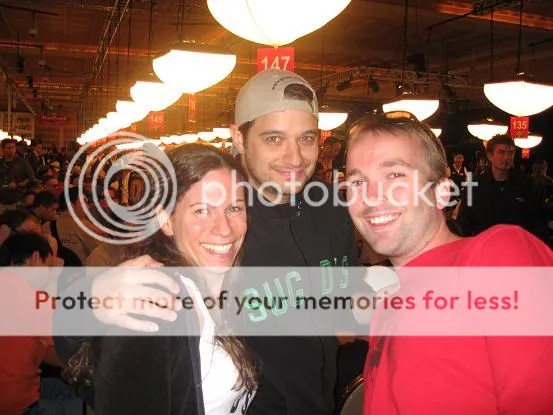
poker groupies.

And now for a word about Kevin. A very strong player in his own right, he failed to qualify for the main event online in 2006, and despite offers from friends and family for financial backing, he chose not to play this year. So after his great run in the main event last year, he was relegated to watching me play in 2006. In an even slightly egocentric person, this would engender feelings of resentment. Poker is a competitive game played by competitive people. And competitive people are often embittered by others’ successes. But Kevin selflessly rooted for me all the way and showed genuine enthusiasm from the rail throughout Days 3 and 4. It didn’t go unnoticed. I am not sure I could have done the same. Thank you, sir.

The start of Day 3 came quickly. I was running a little late, which was good, because I had less time to overthink things before we got underway. I was able to get a quick read on the players, which was important, because this table would not be broken for the duration of the day. Worthy of mention:

I found out through some casual conversation that there was one very strong player at the table. The young kid seated two seats to my right, William Hill, is “MadHatter” on Pokerstars, a deadly online player. In addition to his big live cash, this guy’s winning dwarf mine online. Online winnings are not widely disseminated, and that’s where MadHatter, likely because of his young age, has done most of his damage. I knew to steer clear of Mr. Hill.

Pat Dattilo in the 3 seat was an interesting character. He had won a freeroll to get into the main event, meaning that it hadn’t cost him a dime. It was obvious that he had never played in any kind of poker game approaching these stakes. When I googled him the night before, all I uncovered was a picture of him from a few nights earlier, celebrating his survival of Day 1 at the Voodoo Lounge, the bar at the top of the Rio. This guy was having the ride of his life. Typically, this type of player plays tight and scared, looking to milk every last minute out of the experience. Not so for Mr. Datillo. He was playing pretty tight, but when he got involved, it was difficult to shake him loose. His attitude was a lot closer to “I’m playing with house money” than to “oh my God, I can’t believe I might cash.” He also went out of his way to make it abundantly clear that, like me, he had done his research on his opponents. Within the first ten minutes of play, he addressed both Hill and myself by our first names, and for the remainder of the day, punctuated everything he said to me with my first name (“you’re really playing hard there, David.”). Kevin, Janeen and my parents spent their entire day standing next to Mr. Datillo’s rather vocal wife. I’m not privy to the exact reasons why, but they definitely didn’t enjoy her running commentary.

The player in the 6 seat, to my immediate right, was Erin Hatcher. This was a male, not a female.

To my immediate left, in the 8 seat, was our resident big stack, Ernesto Ibrahim. Mr. Ibrahim was Puerto Rican and spoke almost no English. He had “raise” and “call” down cold, but that’s about it. Soon after we were seated, he asked me, in Spanish, whether I could communicate in his language. “Um, un poco,” I replied. I then explained as best I could that my grandfather was of Hispanic descent. Unfortunately, Mr. Ibrahim treated my barely intelligible response as a license to bombard me with Spanish for the rest of the day. From that point forward, I was subjected to continuous chatter. I could make out about one of every six words and would stupidly nod in agreement, no matter what he said. I think Ernesto knew I couldn’t understand him but did not care. He kept chatting away.

As a player, Ernesto posed a serious problem. He had a huge stack and had come to play. He open-raised a lot of pots, and the way he raised was very telling. At the start of play, the blinds were 600-1200 with a 200 ante. Instead of raising a specific, predetermined amount each time, Ernesto would just dig into his monstrous pile of yellow chips, indiscriminately pull out a stack and push it forward. Sometimes it was 4,000. Sometimes it was 7,000. Sometimes it was 10,000. There was no rhyme or reason; the amount of the raise was determined solely by the number of chips his hand happened to scoop up. The obvious conclusion: this was a reckless player. Another thing that quickly became apparent: Ernesto almost always defended his blind. I was going to have to make a real hand against this guy, he was not going to be bluffed.

Two seats to my left, in the 9 seat, was Patrick Selin. I knew going in that he was the CEO of a poker site that is very popular in Europe, and he looked the part. He had on nice clothes and was nicely groomed. His game, in poker parlance, was TAG, i.e. tight-aggressive.

And finally, in the 10 seat we had Sully. Sully sings for a metal band, and looks exactly like someone who sings for a metal band. He was pierced in a lot of different places and covered in tattoos. I don’t know much about Godsmack, but they obviously sell a lot of records. I know this because the cameras were trained on Sully for most of the day. He was the last celebrity alive in the tournament, and his progress was being tracked closely. Sully was also a very friendly, very nice guy. We actually sort of became friends, and he went out of his way to chat with me during breaks in the action. At the start of play, Sully was very short on chips, in full pushbot mode. But he quickly doubled up twice, and suddenly was sitting on more chips than me.

getting down to biz. Sully in brown t-shirt.

clockwise from R: me, Ernesto, Selin, Sully.

For the remainder of this blog entry, I’m going to make use of Kevin’s handiwork. I will copy and paste Kevin’s diligent progress report emails and add my own commentary below. How convenient.

Update #1:

With 1017 players left, mr z is sitting on approx 55K in chips. I am roughly 3 feet away from him, and approx 5 feet away from sully, lead singer of godsmack. Updates to follow.

It was slow going in the early stages of the day. I watched Sully double up a couple of times, and mostly observed as most of the table, with the exception of my buddy Ernesto, played passively. The good news was that players were dropping like flies around the room.

Update #2:

65K, some nice uncontested pots won. Down to 960 remaining.

I was able to sort of pick my spots, once reraising with AK, forcing an early position raiser to lay his hand down. This garnered a “very nice, David” from Pat Datillo, who was having a good day. I did not acknowledge the remark. The bubble was approaching and I was not in any kind of position to wreak bubble havoc.

Update #3:

everyone has chips, nobody is table leader though. Says dave “pretty passive table”

50k, 945 left. 30 minutes before next break.
I got clipped a few times trying to steal. Ooops. The table was indeed playing scared. Ernesto and Datillo were dominating the action.

Update #4:

On break, 48k. 918 left. Says our horse, “its go time”. For those keeping score at home, sully has managed to take has 11k in chips at the beginning of the day and turn them into over 100k. With an ‘f’ bomb included for good measure.

The way I got down to 48k was disappointing. I had correctly pegged Sully as a tight player. He had actually stated on several occasions “I just want to cash in this thing.” Not a smart thing to say to me. At this point I had chipped up to something like 60k and felt like picking on him.

On the last hand of level two (blinds 800-1600, 300 ante), Selin limped under the gun, Sully called right behind him, and another player called. I was in the cutoff with Q-10 offsuit and called as well. The small blind completed and the big blind checked. The flop came J-J-5, the blinds checked, Selin checked, and Sully led out for 4000. I decided I was going to represent a jack and take this pot away from him, so I bluff-called the bet. Everyone else folded. The turn was another 5, and Sully checked. I executed part two of the plan by firing a nice, fat 9000 bet. I was representing a jack or a five, it really didn’t matter which, as I strongly suspected both had Sully beat. But Sully thought for a second and then called. Crap. I now put Sully on a pocket pair of some sort, maybe 8’s or 9’s, or 10’s. The last card was horrible: a third jack. This gave Sully a presumed full house, and if I held the 5 I had just represented, I was beat, and Sully (probably) knew it. The reality of the situation was that I had nothing. Sully checked. I had a difficult choice: represent quad jacks by moving all in, or give up on the hand. I thought about it and ended up deciding that with the third jack on board, it was now much harder to sell Mr. Sully on the idea that I had a jack in my hand. I also did not know enough about Sully to believe that he would lay down a pocket pair to an all in bet. I sighed deeply and checked, saying “I play the board.” Sully, who was surprisingly nervous for someone who routinely performs in front of thousands of people, also exhaled deeply and showed pocket aces. I definitely did not put him on aces. He played them real funny. Fuckin’ Sully. Ship him the pot.

At the break, I became extremely apprehensive, realizing that it was quite possible that I would bust out on the bubble. The blinds were about to increase to 1000-2000 with a 300 ante. 48,000 chips was not much to work with under those conditions. I also vowed not to deviate from my plan to move all in if the proper situation arose. Bubbling after two and a half full days of poker was distinctly possible indeed. I warned my parents of this possibility, explaining to them that I was not going to stop making moves where appropriate, and that unlike last year, I would not be limping into the money. My mother handled this news in the same way one might react to a phone call bringing unexpected bad news, a cloud of apprehension swept across her face as she likely envisioned how inconsolably pissed I’d be if I bubbled. I noticed this and half-jokingly told my parents to “get ready for some action” or to “strap on your seat belts” or some such nonsense as I returned to my seat.

Incidentally, Sully’s f-bomb timeout occurred when he was all in with pocket 7’s against AK. The cameras raced over as his sevens held, and he looked right into them. Then he exclaimed “did you see the fuckin’ vein pulsing?!?” as he gestured at the side of his neck. The dealer called the floor and they assessed the penalty. Sully sauntered off for his ten minute recess, muttering under his breath.

Back to work, only about an hour from the bubble.

Update #5:

He doubled up!

That was Kevin’s succinct summary of what was by far my most important hand of the tournament. We were something like 25 players from the bubble, and I had just reraised all in from the big blind with AK, picking up around 10,000 chips to increase my stack to around 50,000. On the very next hand, it was my small blind and my Spanish-speaking buddy Ernesto’s big blind. Ernesto had taken a couple of hits and had eased up a bit. Not a lot, just a bit. I had 6-3 offsuit. The table was playing very passively at this point, everyone was looking to get into the money, and they probably didn’t want to mess with Ernesto. All folded to me, leaving me and Ernesto in a battle of the blinds.

There were already 6000 chips sitting in the pot, so there was no way I was folding. A raise made relatively little sense, but I had just won a pot and I made what was probably a silly, impulsive play: I raised to 9000, hoping Ernesto, who had around 140k, would go away. He did not. Instead, he calmly called. Ugh. I was already pissed at myself for making the impulsive raise. I intended to shut down and concede the hand. But then something funny happened. For the first time since Day 1, I hit a flop.

It came 8-6-3 rainbow, giving me bottom 2 pair. Gulp. I gathered myself and bet 10,000. As I pushed the chips forward, I could envision the look of paralyzed fear on Janeen and my mothers’ faces a few feet behind me. It took Ernesto maybe 2 seconds to react by saying “all in.” And it took me perhaps one second to say “I call.” As I said it, I stood up, then turned over the 6-3. Ernesto showed us A-8. And it was now out of my hands.

If you play no limit hold ’em, you know how annoying bottom two pair is. It is usually ahead on the flop, but it frequently gets beat on the turn and river. In this instance, I would lose to an ace, an eight, or worst of all, two running cards higher than 3. I was exactly 75% to win the hand, which doesn’t feel all that secure when you are 20 bust-outs away from a $14,500 payday. Ernesto rose from his seat and I held my breath as the turn card came: another six! I had a full house.

Thinking I had just won the hand (in actuality, Ernesto still had two outs), I launched into my stock instinctive celebration: A sharp pivot to my left and a short, loud, staccato clap, like I was trying to kill a waist-high airborne fly with my hands. I wish I did something cooler than this, but, sadly, this goofy reaction seems to be etched into my DNA. Thankfully, the river was not an eight (which would have brought unspeakable devastation), and I had doubled up. I had 105,000 chips with 898 players remaining.

The next two minutes were awesome. I excitedly gobbled up all my new chips and restacked them (stackity stack stack!). Upon completing that task, I turned around and saw the very excited faces of my cheering section. I stood up, all smiles, and did some restrained rejoicing, blabbing something about six-three offsuit ruling before settling back in. It was more or less official: Barring a total disaster, I was headed for the money. But it wasn’t time to sit back and relax. No sir.

ammunition.

Update #6

890 left, we are hand for hand. Avg stack is 99k. 108k for our horsie.

Stole the blinds.

Update #7

Oh he’s a bully allright. He just eliminated a short stack. He’s at approx 130k.

With Ernesto suddenly a medium/short stack and the bubble only minutes away, there was nothing stopping me. I began to open fire, raising preflop on almost every hand. On the hand that really chipped me up, I had Q5 offsuit in middle position. A short stack who had been clinging to 17,000 was in the big blind. I made a raise to 6,000 and it folded around to him. He looked at his cards, then at me. He silently smiled, looking for a tell. I smiled back. Then he went into a long period of painful contemplation before finally moving all in. I asked for a count, and once the dealer announced that he had around 17,000 I shrugged and said “I call,” which I was mathematically obliged to do. I tabled the Q-5 and the big blind revealed A-J. The flop contained an ace. But it also had two queens. Sweet. I was way ahead. The turn was a jack, giving the big blind two pair, and giving him four outs. I now said to the dealer “how about a deuce?” and the dealer obliged on the river, producing exactly that: a red deuce. I was shipped a very nice, 35,000-ish pot, and I had sent my opponents a message: get the fuck out of my way.

In the span of about 10 minutes I had gone from a short stack, wondering if I’d make the money, to the unquestioned captain of the table. I was sitting with eight rank amateurs and only one other seasoned player. None of these guys was inclined to challenge me until after the bubble burst. I walked to the rail and Kevin stated the obvious: “I don’t think you want the bubble to burst just yet.” Nope. As the tournament entered hand-for-hand (actually “round-for-round”) mode, I was quite proud of the power poker gearshift I had just engineered. But the ride would be ending shortly, and I would regret busting the short stacked man with my Q-5.

When someone busts out of the main event, it sometimes takes about ten to fifteen minutes for the tournament directors to put a replacement in that player’s seat. And that’s about how long the departed short stack’s seat remained empty after I busted him. They replaced him with a player I am familiar with: Jason Strasser. Strasser is 21 years old and is the perfect combination of natural poker ability and dedication to his craft. He is entering his senior year at Duke and has already won more money playing poker than most pros win in their lifetimes. Strasser has only been playing for three years, but has played more poker, thought about more poker and wrote about more poker than practically anyone in the world over that time. He is one of the most respected members of the twoplustwo.com online community, and has authored a wealth of strategic posts there. He is also a resident of New York City, and he was a frequent opponent of mine at the now-defunct New York Players Club in the summer of 2004, when he was only 19 years old.

I vividly recall a confrontation we had in a 2-5 NL game (these stakes are laughable to him now). I had reraised him all in with one pair on a draw-heavy board, and induced a fold. We had exchanged twoplustwo screen names, and the next morning I received a long, thoughtful private message from him about the hand. He concluded that his laydown was incorrect, and he submitted a mathematical proof in support. He was taking the game very seriously and learning it rapidly. Now, it is clear that Jason is both gifted and committed. An awesome player. Today, he is well known in poker circles and has even been featured in Sports Illustrated. On the night before Day 3 started, while I was poking around on the internet, I discovered and actually considered making a proposition bet that he’d finish ahead of Daniel Negraneu.

But his formidable skill wasn’t the worst news. It got much worse. At the time that he was moved to my table, he was the chip leader of the entire tournament, having somehow accumulated somewhere in the neighborhood of 500,000 chips. Physically moving his chips across the floor to his new table was a serious problem: he had two chip runners with him, carrying something like eight racks apiece. As he sat down and began the long process of re-stacking his impossibly vast assortment of chips at our table, looks of apprehension appeared on everyone’s faces. I mumbled something about knowing him to my neighbors. Patrick Selin asked me if he was any good, and I muttered a simple “yes.” No one would be more affected by his presence that me. My very short-lived chip stealing party was over.

Not that I didn’t test the waters one time. I tried a stealraise on Strasser’s first hand. He called the raise then nonchalantly bet the flop, selecting a few yellow chips, a tiny, insignificant chunk of his fortress, one jagged square in a 1,000 piece jigsaw puzzle, and flicked them into the pot. I humbly mucked my cards. Okay. Party officially over.

Mr. Strasser.

The bubble burst after two “round-for-round” orbits. And just like last year, the room went wild. Everyone at table 147 shook hands, except Strasser, who looked utterly disinterested (this, by the way, is his general demeanor at the poker table. He always looks like he’s taking a nap). Across the room, people excitedly prattled away on their cell phones, relaying the good news. Many of the survivors were beside themselves with glee. And last year, so was I. In fact, only 20 minutes earlier, I might have been downright giddy about making the money. Not anymore. I had my sights set much higher now.

From the time the bubble burst until the dinner break, I was a spectator. Strasser and Datillo were going at it, with Datillo refusing to be bullied. Strasser lost two or three large pots to the amateur on failed bluffs. Meanwhile, players were busting at such a rapid rate that the directors had to actually pause the tournament to process payments to all the bustouts in the appropriate order.

And with that, update #8:

Dinner break, 125k is the horses stack, and the avg stack. 750 left. Back in 90.

Dinner was very exciting, as the day was going better than expected. The five of us ate in the sports bar, and everyone was energized with the possibility of a deep run. I felt a lot like the racehorse I had compared myself to in emails to friends back home. I was already guaranteed $16,500. I grew progressively quieter as everyone continued to chatter around me. The racehorse was tired, and was trying to focus on the job that lied ahead. The blinds after dinner: 1,200-2,400 with a 300 ante.

Update #9:

They won’t let me back in! Ugh! (There are biiiig waiting lines outside the venue). Very unfriendly setting here. Hopefully we can get back in.

I haven’t mentioned how tight the security at the main event was. Spectators were allowed in very slowly, to keep the flow of traffic moving along the rails. Hence Kevin’s commentary above.

What Kevin missed was Sully Erna going busto. After his pre-bubble flurry, Sully had slown down and simply bled chips. He was sitting on about 40,000 chips when the following unfortunate sequence of events went down: the player to my right, the man (not woman) named Erin, was under the gun with only about 36,000 chips. He announced that he was all in and pushed his chips in front of his cards. The dealer announced “all in.” It was folded around to Sully, who appeared to be daydreaming. Sully then looked at his cards and called, saying “call” as he put 2,400 (the amount needed to call the big blind) in the pot. At this point, the dealer announced “all in with a call!” and everyone else folded.

Sully, who had only intended to call the big blind, was held to his verbal declaration, which was calling the all-in in front of him. Sully went ballistic, shouting “No way! You’ve got to be kidding me!” as about three cameramen rushed over to our table. He did not call the floor over, however, and Sully was forced to make the call. When the players turned their hands over, Sully was actually ahead: 44 vs. KQ. But a Q fell on the flop, and Sully was decimated, his stack shrinking to only 4,000 chips. And, with the cameras rolling, he continued to rant epithets at the dealer. One hand later, Sully moved all in and busted. He disgustedly got up, gathered his belongings, and for the benefit of the cameras, stood behind the dealer and emphatically flipped him off. The whole thing was unfortunate, but the dealer made the right ruling.

Update #10:

I’m still outside the room, but janeen reports 110k.

I bled off more chips.

Interesting development: apparently Sully’s seat was the designated celebrity (term being used loosely) seat, because he was replaced by Rick Solomon. Yes, the guy who filmed Paris Hilton having sex with him, then turned around and sold it. He was unshaved and wore sandals, baggy shorts, a cartoon t-shirt of some sort, a styled-out baseball cap and designer sunglasses. His demeanor was sorta surferish. All in all, I suppose he was a lot like I would have expected. He was also surprisingly skilled, although he won a very large pot on pure luck. From there, he played solid poker. I never got involved with him.

Update #11:

With about 10 minutes to break, dave is at approx 100k in chips. We are down to 660.

I could not find any good places to get involved and continued to bleed chips.

Update #12

Ok, I’ve entered fort knox. 40 minutes til break, 638 left, dave with 105k, avg stack 135k.

I stole the blinds a time or two. Nothing exciting was going on.

Update #13

We have sprung a leak. Down to 60k. 630 left, 30 mintes to break.

I honestly do not recall the hand that cost me 40,000 chips. It had to be ugly. Perhaps Kevin or Janeen can remind me. In the meantime, players continued to get bounced very quickly.

I do remember, after getting knocked down to 60,000 that I had a lot of trouble even finding a good spot to get involved. Strasser and Datillo were making life difficult, because they could afford to call preflop raises with moderate holdings, then bully their way though hands. I decided that it was too difficult to play smallball with them. I knew they were playing all sorts of mediocre hands, so my plan was to isolate one of them and simply move in. My stack was now only about 10x the amount in the pot. So I decided I’d just start to punish them if they chose to raise into me. I felt rather calm and confident, even though I knew that I might bust soon.

Update #14:

Break time, 60k. About 600 left. One level togo tonight, “reckless abandon time”.

I was now guaranteed $20,600, and Kevin relayed the exact sentiment that I was feeling. With only 60,000 chips and the blinds going to 1,500 and 3,000 with a 400 ante, it was indeed move time. At the first opportunity.

And move I did. Right off the bat during the last level, I reraised Strasser all in with the 87 of diamonds from the big blind. One simple stealraise was now worth 8,000 and I was up to around 70k.

I was both feeling and exuding confidence, despite being a short stack once again. And perhaps because of that, all my stealraises and resteals worked. I had no fear. I never had to show down a hand, and yet I managed to climb to 95,500 by the end of the level. And the end of the level was the end of Day 3.

I bagged my chips and bid my tablemates good luck. My fan club was too tired to wait through the involved bagging, labeling and seat reassignment process, so they gave me hugs/handshakes/kisses and left to catch some sleep. A half hour later, I was free to leave, and I chose to walk back to the Palms. I was exhausted, but my pace was lively as I strode through the Rio towards the door. When I pushed it open, the stifling Vegas air felt sorta refreshing. I made my way up the highway (off the Strip, Vegas is not built for pedestrians), doing something that resembled skipping.

It was my deepest penetration into the main event in my two years playing it. Even though I had only a short stack at the end of the night, Day 3 had been a very satisfying day. I made virtually no mistakes. I won a very big hand at a very important time. More impressive, my sense of my table’s dynamics was acute. I had shown that I knew when to turn up the heat, and that I knew when to take my foot off the gas. I had driven masterfully. I was now guaranteed over $26,000, and I wasn’t done yet. Most of all, my little fan club was proud of me, and I knew it.

Read Day 4 

The 2006 Main Event, Day 2

Having completed Day 1 and done five minutes of gloating, the only thing I wanted to do was sleep. The main event days are a serious grind, so I was mentally spent and physically sore. So Janeen and I went back to the Palms, and after updating this blog, I slept very soundly on Saturday night.

Because of the outrageous number of participants, the early stages of the 2006 main event were quite spread out: four heats for Day 1, and two heats for Day 2. I was now scheduled to play on Day 2A, which was Tuesday. I therefore had two days to kill. Janeen wasn’t flying home until Monday, so we decided to go to a dance club on Sunday night.

The current hot spot on Sunday nights in Las Vegas is Body English, the club at the Hard Rock Hotel. So around midnight, Janeen and I cabbed it over there. It was a mob scene. We finagled our way through the throng of people begging to get in, got waved past the velvet ropes, and just before we reached the register, we looked down and saw a handful of crumped bills lying on the carpet. Janeen scooped them up and handed them to me without examining them: four Benjamins. Ahh, Vegas.

Inside, the club was pretty disappointing. It was small, rammed full of people, with music that rapidly degenerated. Of course, that’s just my subjective opinion. The DJ started out playing some rock remixes. Pretty cool. Then he played short snippets from a bunch of old school hip-hop songs, separating each snippet with the same clip: Greg Nice barking “let’s take it back to the old school, wave ya hands like ya just don’t care.” Coooool. I almost started to freak it. Almost.

But then, predictably, to the delight of everyone else in attendance came the current hip hop hits. This is a sore point with me. I feel like my grandfather must have felt when people started to flock downtown for Charlie Parker and began to pass on Chick Webb at the Savoy, but I just don’t get new hip hop. Especailly one subgenre: I believe it’s called “crunk.” Songs where the MC is just screaming his head off, saying the same thing over and over in a high pitched voice. Ugh. I am not feeling that shit, or almost anything else that moves the crowd in 2006.

How is it that some older MC’s are letting this happen? An experiment should be held: a DJ should cue up Dre and Snoop’s “Deep Cover” (1992) and Snoop’s “Drop It Like It’s Hot” (2005) back to back. The former is a menacing, intelligent, sinister, straight-up badass piece of music. I’ve never held a loaded firearm or bought drugs from a narcotics officer, but I’ll be damned if that song doesn’t give me goosebumps every time. Then there’s “Drop It Like It’s Hot.” It’s an inane attempt to force a stupid catchphrase into the public consciousness? Honestly, I don’t know. I’d challenge anyone to tell me that the new Snoop song is better than the old one. And then I’d demand to know why. Sigh. Whippersnappers nowadays

Anyway, there were some good moments: Gnarls Barkley. Eminem with Nate Dogg (anything featuring Nate Dogg is dope). But after awhile I needed refuge from the crunk, so after two hours at Body English, it was: To the window To the wall To the fuckin’ exit.

That had nothing to do with poker, now did it? Hey, it’s my blog.

Janeen flew back to New York on Monday, leaving me in my cocoon to focus on Day 2. So I went online and scouted the players at my table. No names I recognized. After that, I mostly sat around feeling nervous. Last year, going into Day 2, I had almost no chips, and therefore no expectations. This time, I was going in with a big stack, which changed my prospects. With so much ammunition at my disposal, I could realistically hope to make it deep into the tournament, where the outlandish prize money awaited. And that made me nervous, or more accurately, filled me with a mixture of hope and fear of failure. My parents landed around midnight, and I spoke with my father briefly before getting into bed. Unfortunately, under the covers, no matter how hard I tried, I couldn’t get a barrage of strategic considerations out my head, and I ended up getting almost no sleep.

Running on adrenaline, on Tuesday at around 11:30 am, I headed over to the Rio and met my folks. We had a short conversation, which confirmed that everyone was both excited and slightly intoxicated with the possibilities that lied ahead. Then I went to the Pokerstars suite and picked up a free shirt for my father. Then it was back to work. There were about 1700 players in the room, and we were scheduled to play until that number was pared down to 700. I sat down, unbagged my chips, and then we were underway.

My father and and his free shirt.

My table was a wild one. Each of the first six hands were raised, then reraised preflop, and I chose not to participate in any of them. And then, after perhaps 15 minutes of action, before I could really settle in, the table was unceremoniously broken and we were sent to scattered empty seats throughout the room. On my across the room to my new seat, possibly invigorated by the wild action at the first table, I vowed to play aggressively. It was gonna be my day. My new table was way off in the corner, far away from any spectators, so my parents had come to Vegas to stare at the back of my head from 150 feet and wonder what was going on.

My new table, in relevant part:

Seat 2 was manned by an Indian-looking kid with a medium sized stack. He was doing a lot of chip tricks and acting rather nonchalant. I pegged him as a solid/aggressive player. Behold the power of chip tricks.

Seat 5 was me.

Seat 6 was a young player with a Pocketfives.com card protector. I recognized his face from pictures I’d seen online. It was Matt Graham–online handle “MattG1983.” Over the past two years I’ve watched on Pokerstars as he improved drastically, from a mediocre regular to one of the most feared players on the site. I’d have to be careful with him.

Seat 8 was an older man with a strange white beard. He had a big stack of chips, around 100k. I had no idea what to make of him, but I soon learned he was a tight, conservative player. How he obtained all those chips was a mystery.

Seat 9 was the most interesting character at the table. He was Asian, with bifocals with thick lenses that magnified the size of his eyes. He looked like he was peering at us through a fishbowl. He was sporting a loud teal-colored Hawaiian shirt, but instead of a floral print, it had pictures of playing cards and poker chips all over it, with phrases like “Texas Hold ‘Em” and “All In” repeatedly emblazoned in cursive writing. It was, in a word, hideous (but par for the course in a poker room). This gentleman was, as they say, an “F.O.B.” He was very eager to make conversation, but lacked the requisite skills. His English was virtually unintelligible, and he punctuated almost all of his sentences with bursts of loud, arbitrary laughter, i.e.: “Rook! Frop all crubs. AHAHAHAHAHAHA!” But whenever this guy got involved in a pot, he fell silent. In fact, if he was involved in a hand, he’d act completely detached, feigning interest in the action on the next table over, or suddenly becoming fascinated with his wristwatch. He was a real piece of work. And he had the largest stack at the table by a wide margin, probably triple the amount I had. I decided that he was an idiot who was lucky to be there, and set my crosshairs on him.

In Seat 10 was an odd-looking British guy with roughly the same amount of chips as me. I still don’t know his name, but he had to be relatively famous because reporters from Gutshot.com were keeping close tabs on his progress. His expression switched from genial to pained every time he played a pot.

The only shot of me at my Day 2 table. I’m mid-coniption or something.

I watched a few hands, gathering some of the info outlined above. Then, on the F.O.B.’s big blind, I was dealt the KcJc in middle position. It was folded to me, and I decided that I would begin my assault on him now. With the blinds at 250/500 with a 50 ante, I raised to 1500. Everyone folded except F.O.B., who called. The flop came Q-Q-3, and F.O.B. checked. As promised, I went the aggressive route, firing a standard continuation bet of 3000 into the pot. F.O.B., who had been examining a piece of lint between his thumb and forefinger, looked up, cocked his head sideways, then called. Then he went back to the lint.

The turn was a four. F.O.B. inspected the board for a second andchecked again. I had absolutely nothing, but I put him on a smallish pocket pair, like sixes or sevens. Plus, the plan was aggression, wasn’t it? So I made a strong “go away now” bet of 6000. The dealer said “six thousand to you sir,” and F.O.B., without looking at me or the board, gazed at his massive stack of chips and slowly counted out a very large checkraise. He made it 20,000, one large stack of yellow, which was well over half my remaining chips. Fuck. I couldn’t call this bet, but I sat there pretending to ponder it for a good 45 seconds before flipping my cards into the muck. So much for steamrolling this guy. I had lost one-quarter of my stack messing around with him. I now had about 33k. Time for plan B.

That was the last hand I’d play for awhile. I made one more move at the very end of the level: the player to my immediate right made a standard raise from the cutoff to 1500, and I reheated him to 6000 with pocket fives. It was a dangerous (probably impulsive, stupid) play, if he had called I’d be fairly committed to the hand, and probably forced to gamble on a flop with overcards, but he folded, and I climbed back up to around 36,000 chips at the end of the level. At the break separating Levels 7 and 8, I went and found my parents. I was upset with myself for firing the second barrel at the goofy guy, and my stack had unexpectedly decreased in size. And so my father, in accordance with one of his pet superstitions, went to the men’s room and changed from the obviously unlucky shirt he was wearing into his new Pokerstars shirt.

I was a complete non-factor for almost all of Level 8. I sat there card-dead, bleeding chips. Meanwhile, the tournament had shifted into overdrive. The directors had planned on reaching 700 players around the end of six levels of play on Day 2, but the rate of attrition was outpacing their estimates. By the time we were halfway through Level 8, there were already less than 1000 runners left. And amidst all the action, while most players were either dying off or fattening up, I was just sitting there. My stack was down in the 27,000 range, suddenly below average. And I couldn’t pick up any hands worth playing.

Finally, at the end of the level, I made a rather shrewd play (if I do say so myself). Two hands prior, the Indian kid in Seat 2 had gone all in, shoving forward a massive pile of low-denomination black (100) and green (25) chips, and he was called by the player to my right, who had mostly yellow (1000) and pink (500) in front of him. When the smoke cleared, the player to my right won the hand, and it appeared that he had busted the Indian kid. Assuming he was through, the Indian bolted from his seat and began to make his way through the crowd, towards the exit. But, upon closer examination, the Indian kid’s huge pile of cheapies amounted to more than the player to my right had, and the entire table began to scream at the Indian kid, now 40 feet away, in unison: “you still have chips!” Once we got his attention, he returned, but he was finished mentally; resigned to defeat. On the first hand after his return, with the blinds at 300/600 with a 75 ante, it was folded to him in middle position and he looked at his cards for a nanosecond before going all in for about 2000. He somehow won that pot uncontested (I’m not sure if the big blind was awake or what).

The very next hand, it was once again folded to him, and he went all in again, this time for roughly 3700. I was three seats to his left, and they folded to me. I looked down and saw the A6 of hearts. I knew I was way ahead of the Indian kid’s range of holdings; he was obviously pushing with any two cards. But there were still six players left to act. What to do? I chose to reraise to 8500 in an attempt to isolate the Indian kid. The six players behind me would need to wake up with a monster (QQ-AA?) to call my reraise. Fortunately, everyone else did in fact fold, the Indian kid showed J8 offsuit, and I tabled my A6. An ace flopped, and now the Indian kid’s suicide mission was complete. I picked up a cheap 6500 chips. After the hand, whitebeard looked at me and said “I had you beat.” “Yes, but I reraised first,” I replied. Good play, David. Still, at the break between levels 8 and 9, I had only 32,000 chips.

I found my parents again. This time my mood was definitely sour. I still had a decent amount of chips relative to the blinds, but the average player left in the field had now run past me. And I had not seen any hands better than Ace-Ten in four hours. I was very frustrated, but I managed to remind myself not to allow my emotions to control my play. No limit tournaments like the WSOP events are, in many respects, a contest to see who can make the fewest mistakes. The mistake-free players, over the course of several days, eat the mistake-prone players alive. And mistakes emanate from different sources. Some are functions of a player’s actual ability: inexperience, poor recognition, et. al can cause mistakes. But other mistakes are correlated with the length and pressure of the tournament: fatigue, frustration, and recklessness also cause mistakes. I realized that I might be on the verge of committing this second class of mistake, and I promised myself not to allow it to happen.

It’s a good thing I gave myself the pep talk, because Level 9 didn’t treat me any better. I simply could not find a hand that was worth playing. I managed to steal a couple of blinds here and there, but I continued to tread water while players around me either went bust or skyrocketed up the chip count chart. My card-dead period was verging on ridiculous.

There was some interesting turnover at my table during this level. The Indian kid was replaced by a black guy in his mid-20’s with a giant stack. And then, shortly after that, the player to the black guy’s left busted, and was replaced by Tex Barch.

If you watched last year’s main event, you’d recognize Tex Barch. He’s the guy who finished third, cashing for 2.5 million. At the final table, he was the guy who derailed Andy Black when Black held the chip lead, and he was the guy who lost what then was the largest pot (as measured by the total number of chips involved) in WSOP history when he got eliminated in a three-way confrontation with Joe Hachem and Steve Dannenman. Barch looks a lot younger than his 35 years, and he exudes confidence. He’s also a very thoughtful player. His pace is very deliberate; it’s obvious that he analyzes, scrutinizes and dissects every decision he must make. When it’s his turn to act, you can practically hear the wheels turning in his head. He showed up at the table with a solid stack.

At the end of Level 9, I had some strong new players to contend with, but I hadn’t made a move for over two hours. The end of the level brought with it the dinner break, and at that point the tournament director announced that we’d be playing only one and a half more levels before calling it a night. Players were being eliminated too rapidly.

At dinner, I came to terms with the fact that I would have to make a courageous move or two during the next level. With a 30,000-ish stack and blinds at 500/1000 with a 200 ante, I would have less than ten times the amount in the pot in front of me. This meant that I’d have to employ an all-in reraise or two.

This is a move that was fairly new in my arsenal. It was introduced to me by Blair Rodman and Lee Nelson’s book “Kill Phil” and then thoroughly reinforced by the instructors at PokerXFactor.com. The concept goes as follows: allowing your stack to drift down to four or five times the amount in the pot is a last resort. It is far better to make a reraise, preferably against an aggressive player, while you still have fold equity, i.e. enough chips to force a preflop raiser to fold. This is a real power move, and while it helps to have a hand to fall back on, it can be executed with or without a strong hand. The hardest part about this move is that it takes heart. You have to summon the guts to put your tournament on the line knowing that you are reraising a player with a better hand than yours. The move, obviously, becomes a complete disaster if the raiser has a monster hand, or if the raiser somehow figures out what you are up to and calls. So you have to both select your spot carefully and have the audacity to shove your chips in.

At the start of Level 10, a huge confrontation between the black guy and Tex Barch unfolded. It was folded to the black kid in the small blind, and he raised to 4,000. Barch called from the big blind. The flop was A-A-10, and the black kid bet 6,000. Barch called. The turn was a 6. The black kid now bet 12,000, and Barch called again. The river was a 3, and the black kid bet 30,000 chips, a very big bet. Barch though for a few seconds and called. The black kid tabled AQ, but Barch had A3 for a lucky rivered full house. Barch’s stack became very large, and the black kid was crippled. And from that point forward, Barch began to play very aggressively, raising almost every time it was folded to him. My drought continued, I bled away chips until i was down to around 15,000. Something had to happen soon.

Finally, I was on the button and Barch was in late position, two seats to my right. It was folded to him, and he raised to 3500. I correctly surmised that 1) after winning the big pot, Tex was switching into an aggressive mode of play and probably only had a moderate hand; 2) I had a very tight image and a reraise would look like a superstrong hand; and 3) I had enough chips to make him fold. I made my long-planned reraise, and for the first time in the entire tournament, I was all in. After everyone else folded, Barch looked at me and said “you haven’t played a hand since I got here,” and promptly folded. I gained 7000 chips with the move. The hand I held, which happens to be the least relevant factor in the analysis: pocket sixes. I now had around 22,000

Still, I continued to bleed chips. There were just no opportunities. Then, one orbit later, something big finally happened. I was under the gun, and in the seventh hour of Day 2, I finally saw my first big hand of the day: pocket aces. I made a standard raise to 3,500. It got folded around to the British player, who had around 50,000 chips, and he announced a reraise (yes!). He made it 9,000 to go. At that moment, I knew I was going to respond by pushing in my remaing 18,000 chips, but it was absolutely vital that I entice him to call. When the action came back around to me, I went into a long act. First, I rechecked my hole cards. Next, I simply sat there for ten seconds. I blinked a few times. I wanted this guy to think that his bet had put me in an impossible situation. So I separated 5,500 chips from my stack, pretending to gauge where calling this bet would leave me. I stared at the two separated piles of chips for a few moments, then, in an act designed to look impulsive, quickly rearranged everything into one stack and haphazardly shoved it all in. Then I said what was already apparent: “I’m all in.”

The British guy did not like this development, but it didn’t take him long to say “I really hope this is a race” as he called and turned over pocket fives. I showed my aces, and now it was in the dealer’s hands. I was all in for the second time in the tournament. I can’t recall what the board was, but it didn’t bring a five, and I raked a large pot that put me just above the 50,000 mark, which was a little below the average stack in the room. The British guy had been playing tight all day, and so had I, so I was really puzzled by his reraise with 55, but it sure came at a great time. Now it was time to switch mindsets. There was no longer any reason to worry about gutsy all-ins. For the first time since my failed charge against the goofy Asian guy, I could exert some pressure without putting my tournament on the line.

Not much really happened with me between there and the end of the night. I still didn’t have enough chips to really open up, and I just couldn’t find many good opportunities. I still managed to pick a few spots for steals, which chipped me up to 62,000. It was somewhere in the short-to-medium range.

The black kid, who had come to the table with a big stack, went busto soon after Tex Barch crippled him. And then Barch was stopped cold in his tracks by Matt Graham, the internet kid to my left. On the key hand, Graham played Barch like a fiddle, goading him into bluffing off 75% of his stack on the turn and river. Barch, who had played (and talked) a mean game up until that point, petulantly stormed away from the table after being outplayed by the 22 year-old.

When the day was over, I again located my parents, who were very tired but beaming, despite having seen absolutely nothing I did. I was still alive. I had taken my first real punishment on Day 2, but I had regrouped and made a solid comeback. Now we had two days in Vegas before Day 3. I wasn’t sure how we’d kill that time, but with my father around, there was a pretty good chance that it might involve shooting dice.

Read Day 3 

The 2006 Main Event, Day 1

There are good things about being a professional poker player, and there are bad things about being a professional poker player. Many of the good things are obvious. I make my own schedule. Poker is fun. Stuff like that.

The bad things can be more subtle. One of them is that the World Series of Poker’s main event, once you “go pro,” feels less like a big party and more like an actual poker tournament. By that, I mean to say that a professional has real positive expectations going in. A recreational player is just happy to be there and soak in the spectacle. And so, I’m sorry to say, the blog entries on my 2006 main event are unlikely to have the same flair and sense of wide-eyed wonder as my 2005 expose. All I can do is recount the experience from my current point of view. Sorry!

I left for the 2006 main event on July 26, two days before I was scheduled to play. And like last year, my flight was filled with giddy poker players. As I made my way to my seat, I spotted a few titles in the ever-expanding universe of instructional poker publications. Another passenger/player, a young blond kid, actually turned to his friend and made note of this. I joined in the conversation by saying “half this flight is playing,” accompanying the comment with a knowing wink. The rest of my flight was uneventful. The six-hour trip to Vegas has become routine for me; it’s my commute to work. No last-minute cramming with my nose buried in Harrington this year. Instead, I flipped my little TV to ESPN News and took a nap.

When I descended from the plane into the oven otherwise known as Vegas in July, my mindset began to transform. I entered my practiced, semi-meditative preparatory state. I’m not sure how to best describe it other than to say that I become focused. It feels the same as preparing for oral argument in Family Court, except the overriding emotion is anticipation instead of contempt.

I got my bags and headed to the Palms, where Pokerstars would be picking up the tab. They also provided me with a variety of sports jerseys that I will never wear. My room wasn’t ready, but my timing was just right: The Pokershare press conference, in which they were scheduled to introduce Mikey, the chimpanzee whom they intended to enter into the tournament, was just starting. I have discussed this event in some detail in a previous blog entry, so I won’t get into it again here. In short, I must report that Mikey’s poker prowess is underwhelming. He was, however, very adept at eating poker chips and whacking things. He also pooped his diaper.

By the time the press conference ended, my room was ready, and I settled in. Matt was already in Vegas, so we later met up and enjoyed a relatively tame night out. And with that, on Friday morning I went into full cocoon mode up in my hotel room. The next time I would do anything remotely interesting, the main event would be underway.

On Saturday, Day 1B of the main event (Day 1 was split into four heats), it was finally time to play poker. In the hours before the tournament, I struggled to reconcile two competing pieces of information. First, I knew going in that I had at least a moderate skill level advantage on the average runner in the tournament. The main event is a very peculiar and exciting tournament for one simple reason: everyone and their mother plays. The grizzled pros are there. The internet whiz kids are there. The home game heroes from across the globe are there. The wealthy curiosity seekers are there. The end result is that skill levels run the gamut, all the way from the best players on earth down to oblivious rank amateurs. So I knew going in that my skill was significantly above the mean. My chances of cashing in a typical tournament are about 20%. I figured my chances in the WSOP main event were more in the 30% range.

The other piece of information bouncing around in my brain was that my skill advantage might not matter at all. There were situations that would lead to early elimination, and there was nothing I could do about it. I had no way of controlling the luck element, even with the main event’s long, gradual structure, which is designed to emphasize skill and minimize bastard luck. I reported to my seat (table 180, seat 9) knowing that I lacked full control over my fate, but also realizing that a quick exit would be bitterly disappointing. After all, last year I had finished 290th, a result which hastened my decision to play poker for a living. Janeen had flown in the night before, so between her and Matt, I had two railbirds of my very own. Like last year, my parents were scheduled to arrive between Days 1 and 2, creating a little bit of extra incentive to make it through Saturday.

The early stages of an expensive deep-stacked tournament are a lot like the first round of a heavyweight title fight. You spend some time sizing up your opponents, learning their tendencies and rhythms. You’re trying to pick your spots land some blows. And if (and only if) the perfect opportunity presents itself, you can try and knock someone out. Otherwise, it’s stick and move, stick and move. Accumulate chips slowly.

That’s not to say that you won’t get knocked the fuck out. As I said before, one cannot control the luck element. On any particular hand, you might get cold-decked (e.g. KK vs. AA; set over set) or sucked out on (e.g. any number of violations of the laws of probability). You go in knowing that some opponents will be throwing haymakers. Even though landing counterpunches against these particular opponents is easy, they remain dangerous because you never know when you might be standing in exactly the wrong location in the space/time continuum and get clipped by one of their roundhouse rights.

Thankfully, once Doyle Brunson stepped to the mic to utter the famous words “shuffle up and deal,” I no longer could afford to contemplate my fate. All 206 tables in the Rio’s Amazon Room were at capacity, with hundreds of “alternates” waiting in the wings. A total zoo. For the players in my heat, the most colossal poker tournament ever was finally underway.

And my table was a good one. Within the first half hour of play, I was able to determine that there was exactly one highly skilled player at my table, an Asian kid in seat 4. Unlike last year (Bobby Baldwin), no one’s face looked familiar. There were players of all kinds, but no one intimidating. We had wild and reckless (seat 2), super-tight and scared (seat 8 ), and more entertaining than the rest, the utterly clueless (seat 3). Seat three was an Asian guy with a thick accent who qualified on Pokerstars, per his hat and shirt. The funny part about this guy was that he obviously had never played live poker before. I know this because he would post blinds at random intervals and consistently raise/bet/fold out of turn. Repeatedly, we had to politely explain to him that there were no “auto fold,” “auto raise” or “auto call” buttons in live play, you have to act in turn. Clockwise.

Before I could make the analysis found in the above paragraph, I proceeded to lose a bunch of chips. On the second hand of the entire tournament, I called Seat 4’s under the gun raise to 125 with the A2 of spades. I was looking to flop a flush draw, but I couldn’t fold when the flop came A 3 5 rainbow, giving me top pair and a gutterball wheel draw. He led for 250 and I called. The turn was a 7, and I checked behind him, looking to keep the pot small. The river was an ace, and he fired 600. There was no way I was going to lay down trip aces against someone I’d never seen before in my life, so I called. He showed AJ, and I mucked. So right from the start, I was in the hole, riffling fewer chips than anyone else at my table. The rest of level one went by without incident.

Level two was a different story. With 3 callers in front of me, I called a minimum raise with the ace and six of spades from the big blind, and ended up winning a 1000-ish pot with two pair. And then, still in the early stages of level two, I happened upon a hand that would end up springboarding me through the day.

The blinds were 50 and 100, and I was in the big blind. I looked down and found pocket aces. I was dismayed to see the action folded all the way to the button, but things picked up rapidly from there. The button raised to 150. Then the small blind, a very tight player, deliberately raised to 600. I was virtually certain that this was not a move but was indicative of a big hand, either AK or a pair above 10 10. So, rather than get tricky with the aces, I tried to get the small blind to commit all his chips preflop. I dug down into my stack, past the green chips (25), past the black chips (100), and past the pinks (500). I separated three yellow 1000’s from the pile, said “reraise,” and flicked them into the pot. This was by far the largest bet my table had seen thus far, and everyone sat wide eyed and alert, waiting to see what would happen next. The button quickly folded, but the small blind, an amiable, goateed fellow from somewhere in the south, began to hem and haw.

I was studying him closely and knew that the long pause was not an act. He was very seriously considering the proper response to my massive reraise. Finally, after a long while, he said “call,” and gently placed 2400 chips in front of him, completing the bet. I knew he had one of exactly two hands: QQ or KK. Trapping with AA was both very unlikely (since I held that hand too) and beyond the scope of his game. JJ, AK and worse did not fit his image–extremely tight–at all. It was QQ or KK, and we were about to play a pot that would likely bust one of us. I prayed for no paint as the dealer burned and turned.

My prayers went unanswered. The flop came Q, rag, rag, meaning that my goateed friend might have flopped a set. His physical actions were consistent with someone who had three queens. He paused, frowned, then checked. I instantly checked behind. The turn was another rag. Again another pause, then a check. And again I checked behind. The river was a six, which paired one of the flop cards. Again came a pause and a check. Now I was virtually certain that I was facing KK, as queens full would have value bet the river. So now it was my turn to value bet. It was a close call between shoving all in and betting something more moderate. I had a sense that the goatee had correctly put me on aces, and was very scared of going broke so early in the tournament. So I decided to bet a little more than half the pot, 3500. When I did, my opponent frowned, erasing any lingering doubt about whether my hand was good. He then painstakingly called. I flipped open the aces, and he mucked two black kings face up. I was suddenly sitting on 17500 chips. And this was bad news for the other players at my table, who now faced a deficit in both firepower and skill. I played a few more hands during Level 2, and ended the level with around 16000 chips.

Somewhere in the middle of Level 3, they regrettably broke my table. My new seat assignment was not a good one. I was seated amongst several 20,000+ stacks. Even worse, I looked four seats to my left and found Patrik Antonius. Antonius’ is not yet a household name, but in my opinion, he is one of the top two no limit hold ’em tournament players in the world right now (Phil Ivey). I would categorize his style as loose, aggressive and pesky. Loose because he plays a lot of pots, with a huge range of holdings. Aggressive because he bets and raises any time you show weakness. And pesky because hands against Antonius don’t usually end on the flop. He loves to call or raise on the flop, then take pots away from his opponent on the turn or river. He’s totally fearless and will put his tournament on the line at any time. Every pot against him could end up becoming a huge one. I’m not too proud to admit that I wanted no part of him whatsoever. And I’ll also happily tell you that when my new table broke only 20 minutes after my arrival, I silently rejoiced.

At my new table, I was a medium/large stack, and I found immediate success. I worked my stack up to around 20,000 using standard aggressive play. When we broke for dinner, the tournament was exiting the conservative “poke and prod” phase and entering a new stage wherein stack size disparity required some more aggressive situational play. My goal was now to finish the day with 30,000 chips, which would be an above-average stack heading into Day 2.

Before the dinner break, Janeen and Matt staked out a table for us in the Rio’s sports bar. It was about 7:15, and I had played three of the six scheduled levels, and I knew that surviving the day would take me through 3:00 am. I was excited, but also preoccupied with staying mentally sharp. After dinner, Matt departed to partake in some traditional Vegas fun, but Janeen, my number one fan, hung in there, displaying an unusual tolerance for tournament poker, which is really not a spectator sport without the hole card cameras.

Level 4 featured 100-200 blinds and a 25 ante, which ramped up both the amount in the pot preflop and the short stacks’ level of desperation. Action ensued. First I flat called a middle position raise of 700 with AQ offsuit on the button. The flop came J J 8 with two spades, and I had none of it. The middle position player bet 1800, leaving him with about 5000 behind. I sensed that he didn’t like his hand, so I put him all in and he quickly mucked, pushing my chip count up to around 24k. Nice bluff.

Next I limped in early position with AJ. I got called in one place, and the flop came A J 6 with two clubs. I led at the pot for 600, and my opponent, sitting on about 10k in chips, raised to 1200. I flat called, knowing I’d be putting him to the test on the turn. The turn was an offsuit rag, and I checked. My opponent now bet 1500, and I moved in. He showed an ace and mucked. I had around 28k, and was using the threat of elimination as a weapon against my foes. I could feel the table beginning to succumb, which is a very good thing.

On the next hand I played, I decided to get tricky by limping under the gun with two red aces. Unfortunately, this play did not go as planned, as I got called in five separate places. The flop came Q J rag with two diamonds. I checked, and it was checked all the way around to the button, who bet 500, leaving him with 2500 behind. I checkraised to 3000, putting him to the test. I was relieved when it was folded back around to him. He reluctantly called, tabling Q10. He didn’t catch and I was now sitting on over 30k. Now the largest stack at the table, and having reached my chip goal with 2 full levels left to play, I proceeded to open fire, stealraising frequently.

At the break separating Levels 4 and 5, my confidence was cresting. There was no one at my current table with the guts to stop me in my tracks, and I realized I was a big favorite to not only make it through Day 1, but to do so with plenty of chips at my disposal. I did, however, make a conscious decision at that time to slow down a bit, knowing that the other players would start to liberally employ reraises if I continued to play recklessly.

Accordingly, I reined it in a bit during level 5, choosing to pick on one player in particular: a loose-passive older man sitting four seats to my left. I noticed that he liked to get involved, but was unwilling to call large bets without the nuts. And so I zeroed in. First I forced him out of a pot with AdQd when I flopped a big draw. Next, I made the same move against him with pocket aces, hoping for a call that never came. And finally, I made a somewhat daring resteal against him with 76 suited. This final move led him to scowl at me and mutter “I know I have you beat” as he folded. Yes sir. Yes, you do.

I was up to about 35k by the end of the level. The most intriguing development of the level was probably the arrival, around midnight, of a new player. He was 21 years old, wore braces (!), and was extremely talkative. He played a fairly standard game, but gave off the illusion of extreme aggression due to his demeanor at the table. In short, he was obnoxious. He refused to post his blinds or even fold his hand without accompanying the action with a comment of some sort, usually a stupid and/or derogatory one. His act grew old real fast. Yawn. But this genius almost immediately won a huge pot by getting all his chips in with QQ against KK (queen flopped), which gave him a very large stack and made him the most dangerous player at the table.

Janeen was over on the rail with his older brother, so I got this kid’s story at the break. He’s a college student that lives in Beverly Hills with his parents, who posted his entry fee as a present of some sort. His persona, sadly, was very consistent with this background info. I wanted very badly to bust his ass.

At the start of Level 6 (200-400 blinds), I picked up AA for the fourth time. Three players had already called 1200, so I made it 6200 and got no action. I now had around 40k. I next lost a couple of hands, including a maddening encounter with the annoying kid, but I regained my footing and began, once again, to steal liberally. It was approaching 2:00 am and I could sense that many players simply wanted to survive until Day 2, which created an artifical bubble of sorts. This made it easy to run over the table, and that’s what I did. But there were a couple of exceptions. Although the end of the day was approaching, there were maybe two players at my table who were tired of my aggression. And that led to the following hand, which I am rather proud of.

I had Ac6c on the button, and I called a raise from a player in early position. It was a Scandinavian player who had been recently relocated to his seat, but who had witnessed a series of steals from yours truly. The flop was an unusual one: three tens. The Scandinavian kid checked, and so did I. The turn was a three. Once again we both checked, and I began to suspect that my ace high was good. The river was a jack, making the board 10-10-10-3-J, and the Scandinavian player checked one last time. I was somehow certain that my ace high was either good, or at worst, a tie.

In the past I would have simply opened up my hand, but this time I decided to value bet, putting 2000 in. The Scandinavian kid responded by going into a chip-shuffling act and then checkraising to 5000. What? This play made no sense. A small pocket pair would have tried to protect itself by betting on an earlier street. A jack would have bet or check-called, fearful of reopening the betting to possible quad tens. Quad tens would have value bet the river. The checkraise just made no sense unless it was a total bluff. I called his 3000-chip raise instantly, in much less time than it took me to type out that explanation. When I did, the Scandinavian kid looked resigned and I could tell my hand was the winner. Nevertheless, I had a point I wished to make to the table. I was not done with the hand. The kid was the last aggressor and he had to either show his hand or muck it before I was obliged to act. He continued to sit there doing nothing, so I looked at him and then the dealer as I shrugged and turned my palms upward. Finally, the kid sheepishly turned over one king. I revealed my hand and derisively said “ace high” in a loud tone as I scooped up the pot. I wanted to deliver a message to this table: mess with me at your own peril. I was now sitting on a bloated 50k, over double the average stack in the room.

That was the high point of my night. With under 10 minutes to play, I went into hyperaggressive maniac mode in an effort to pile up more chips. It worked on every occasion except one. I raised under the gun with 43 offsuit on the very last hand of the night. Unfortunately, Braces called from the button and refused to be bullied on an ace high flop. We checked it down from there and he showed pocket 8s, thus taking the table chip lead away from me on the final hand of the night.

When my Day 1 marathon was over, I had 42,000 chips. I completed the day without ever going all in. I was never in danger of going bust. I consistently outplayed my opponents and had enjoyed a nice, steady climb up the chip count ladder. The only “lucky” aspect of my day was that I had picked up pocket aces five times, and one of those times an opponent had held pocket kings. Beyond that, it was all deft maneuvering.

When the Day 1 clock expired somewhere around 2:30 am, some anecdotal evidence of my status as professional poker player amongst amateurs: while most of the room broke out in wild applause, I retained my composure. I was already considering my Day 2 strategy.

But then, after we bagged our chips, some rather unprofessional exuberance: I found Janeen and Matt (back after a night out drinking) and proclaimed “I just put on a fucking clinic at that last table!”

Read Day 2

Sug = #259

So I have finished 259th in the WSOP Main Event, which was good for $38,759. I still cannot summon the energy to write a detailed blog entry about the tournament (and it doesn’t help that I stopped taking notes after two days).

In short, I am happy with my play. The tournament required that I go through several different phases, ranging from hours of supertight play to pockets of hyperaggressive activity. I passed most of the tests I faced with flying colors.

I am proud to have improved on my 2005 finish, and I’m acutely aware of the fact that my game has evolved greatly since that time. The hand that busted me is illustrative of this fact: it was a daring squeeze-play reraise gone wrong. Making the reraise would never have occurred to me last year; the move wasn’t even in my arsenal. Then again, last year, I’d never have lived long enough to make the same play.

I suppose I’m slightly disappointed that I failed to get into the big money, but 39 grand is nothing to sneeze at. Both my bottom line and my tournament resume look a lot nicer than they did a week ago. I have no regrets.

I fly back to NYC sometime in the next 48 hours and then it’s back to the grind.